Rubieta fell away behind them, a glittering red wound of a world, its canyons and domes shrinking in the aft displays until the planet was just one more hazard light in the dark. The Serendipity had come there carrying ghosts in its systems and blank bodies in its hold, with Axiom’s shadow stretching farther than anyone aboard cared to think about. It left a little richer by two awakened clones, a good deal poorer in the purse, and saddled with the suspicion that the universe wasn’t actually large enough to outrun everything chasing them.
For a while, the crew didn’t run. Not exactly.
They drifted near the station above Rubieta, close enough to come and go, far enough to dodge the berthing fees some bureaucrat could meter out by the hour. The officials there had layered charge upon charge, a whole ecosystem of quiet predation dressed up as regulation. Jun Minh had cut through that kind of thing before, and even she couldn’t make the place hospitable. So Gray held the Serendipity in a patient orbit, dipping in only when they had to, while the others spent a week doing what spacers had always done when law, commerce, and survival got tangled together. They went looking for people who knew people.
Cassian had a talent for low doors and quiet names; he could sit in the wrong bar long enough for it to turn into the right one. Daniil knew how smugglers circled a job without ever saying what it was. Konrad could tell which lies lived inside official systems and which ones lived outside them. And Jarek understood the sort of men and women who measured trust by whether you flinched when they looked at you.
The question was simple. How did you get into Triumvirate Ascendancy space without wearing a leash?
The official route existed, of course, but the Ascendancy didn’t just sell you a rudder and wish you well. The price came bundled with a transponder, a polite little parasite wired into the ship, broadcasting your identity and origin and status and your outsiderness to anyone who cared to listen. In Ascendancy space, being unknown made you suspicious. Being known as an outsider was worse.
The answer, when it came, was the usual black-market kind. The rudder itself wasn’t hard to find; the trade routes moved too much money to stay secret. But arriving without the right signal would draw exactly the attention they wanted to avoid. For a thousand credits, a broker could hand over both the current path and a dedicated false transponder, a crude but serviceable piece of hardware. It wasn’t elegant and it wasn’t flexible, but it would broadcast a single chosen fiction, and it wouldn’t draw power the ship couldn’t spare.
The crew argued over names and affiliations the way people argue when they know a bad lie can turn into a death sentence. Claiming House Sothane authority was tempting in the way standing on a cracked hull plate is tempting. It might hold. It might also drop you into vacuum. Better to be a free trader, obscure and unremarkable, at least until they understood the society they were sneaking into.
So the Serendipity kept her bones and put on a different face.
Cassian used that week for a quieter kind of preparation, too. One by one, those who were willing trained with him until they could open a channel to his mind with a thought. Not a broadcast, and not speech, but something more intimate and more dangerous, a flare in the dark that he could answer. The cost fell on him, not on them, and the value was obvious. On a ship crowded with secrets, fugitives, clones, and a robot with strong opinions about human leakage, another way to talk seemed worth the discomfort.
Then they left Rubieta behind.
Gray took them through drill space cleanly. This time the geometry beyond reality didn’t claw at the hull, the clones didn’t whisper impossible messages out of stasis, and no nightmare current tried to drag them sideways into whatever waited between the mapped places. Cassian watched the newly imprinted ones the whole way, all the same, studying them for any sign of the thing they had once heard through sealed capsules. We are seen.
Nothing happened.
That almost made it worse.
Ascendancy space received them not with alarms but with commerce. For three months they worked its outer worlds, hauling what they could, selling what they dared, and learning the shape of power from the trails money left behind. The first month was lean and a little humiliating, a lesson in how little capital they had and how fast a bad contract could swallow fuel and fees and time. Jun smoothed conversations. Konrad watched records and routes. Daniil kept the ship’s practical needs from eating them alive. Gray made the jumps and burns look easier than they were. Jarek stood where it helped to have someone standing.
They turned a profit, then a better one, then lost a chunk of it again.
By the end of the circuit they had more than they’d started with, though not enough to pretend they were anything but desperate people with a ship. The Serendipity’s maintenance costs loomed over everything like a second gravity well. Honest hauling would keep them breathing. It wouldn’t make them free.
What the months did buy them was knowledge.
Fynip, the nearest Ascendancy system, belonged in the old stories to House Sothane and its peers. Those noble houses had wielded real power once. A century back, war and political upheaval had stripped most of it away. Their world, Triaku, still held wealth and pageantry, but the splendor had started to rot from the inside. Noble families were selling heirlooms out of their vaults to keep up estates they could no longer afford and influence they could no longer promise.
Elsewhere in the system sat Chracle, a barely habitable world scarred with the leavings of a dead alien civilization, catacombs and tombs and unanswered questions under a hostile sky. There was Romanti, too, where one of the Ascendancy’s ideological pillars maintained an agrarian world on purpose, hoarding technology and authority in small, controlled centers while everyone else stayed close to soil and labor. The Ascendancy wasn’t one thing. It was a bargain between factions, military and economic and scientific and ideological, spread across distances that should have made any unity fragile.
Maybe it was fragile. Maybe that was why everyone watched everyone else.
The crew listened for anything that brushed up against their deeper problems: clones, psionics, Axiom, drill space, the strange minds that might or might not be waiting in it. Two leads surfaced.
The first was a psychic commune on Chracle, a small settlement inviting other psychics to join them in something they called communion. The word hung in the air unpleasantly. To Jun it had the shape of both temptation and warning. To the others it sounded like a cult with a better vocabulary.
The second was a derelict installation found far out in deep space, in the Zuhayda-Urkan system. Long-range scans had picked it up, classified it as a lost object, and carved it into salvage claims before anyone really knew what it was. Three companies had bought the rights to cut it apart. The reports said it wasn’t human-built. The reports also said it objected.
That job paid hazard money.
In the end the choice was easy. Nobody was paying them to go poke a psychic commune. Somebody was paying them to run supplies to the haunted alien station.
The contract came through on Magino, an orbital hub where the Serendipity took on heavy equipment, food, water, and the kind of bland survival supplies that keep workers alive in places nobody should have to work. The destination wasn’t a name but a designation: OD-XI-8847. Object, derelict. A number standing in for a history.
The delivery itself was straightforward, in-system, no drill jump needed. Twelve hundred credits to haul supplies to a dangerous site where, officially, no ship had ever been damaged. That last part didn’t reassure anyone.
While the cargo loaders worked, a message came in for the captain of the Serendipity.
The man in the recording was heavyset and richly dressed, artfully composed, with a high, wide collar and a mustache curled into something like elegance. He sat behind a desk in an office that looked a size too small for the grandeur he wanted it to imply.
His name was Renko Salavast. He represented moneyed interests. He had a business opportunity.
That alone was enough to make him dangerous.
Before going to meet him, the crew asked around. Salavast was known, though not well. A fixer, a broker, a man who served noble interests out of Triaku when those interests needed something handled at a careful distance. He hired people for gray work, sometimes a good deal darker than gray. Nobody could say he never paid. Nobody could say he could be trusted, either. The usual rules applied: don’t show him a weakness and expect him to leave it alone.
Jun, Cassian, and Jarek went to the meeting.
Salavast’s office in the Mercantile Concourse was a cramped shrine to importance. The sign outside called it a brokerage and appraisal concern. Inside, the desk was old wood, polished and heavy, the kind of thing meant to suggest lineage. The visitor chairs were metal and uncomfortable. Glass-fronted cabinets held small sculptures and artifacts arranged with careful theatricality, and a tea station occupied a place of honor.
Salavast welcomed them warmly and offered tea from Triaku, brought in, he assured them, at considerable personal expense.
Jun accepted with the right amount of restraint. Refusing would have insulted him; asking for too much would have been worse. He made the tea with conspicuous care, heating the water, measuring the leaves, giving the ritual enough weight that it turned into something between hospitality and performance. Cassian brushed the edge of the man’s mood and found him calm and confident, entirely at ease in his own stage lighting.
The tea was genuinely good.
The art, less so.
As Salavast talked up his collection, Cassian saw enough to spot the seams. The pieces might have impressed an untrained eye, but a lot of them were probably fakes, imitations of older styles, or objects wearing histories grander than their materials deserved. Whether Salavast knew it was harder to say. Maybe he was a connoisseur of fraud. Maybe he was just a man playing at refinement while he drowned in somebody else’s fading nobility.
Either way, what he wanted was alien artifacts.
He’d heard rumors that non-human objects had turned up aboard OD-XI-8847. The salvage companies had gone quiet about their progress, which meant either they’d found nothing or they’d found something worth hiding. Since the Serendipity was bound for the site anyway, Salavast offered a finder’s fee. Two hundred credits for each piece of non-human origin they happened to come away with, and possibly more after appraisal for anything particularly valuable.
Jun understood the legal shape of the offer right away. Everything aboard the station technically belonged to the salvage teams that held the claims. Alien artifacts were regulated on top of that, especially the ones whose function nobody could pin down. The proper process meant reporting and inspection. Authorities liked caution; unknown alien devices had a way of making bureaucrats picture dead cities and lawsuits.
Salavast wasn’t asking them to follow the proper process.
He did give them something useful, though.
The derelict had been split among three groups. The Drovik-Nar Salvage Cooperative was a reputable enough outfit out of Magino, experienced at cutting apart old ships and stations. Halvian Sons was newer and hungrier, built from the wreckage of a fallen noble family clawing its way back toward relevance. Their lead captain was Renata Halvey, with her grown sons running the other vessels. The third claim was the interesting one. It had gone to a mercenary outfit calling itself the Knot, which had then subcontracted out the actual salvage work.
The Knot had a poor reputation. Rough, willing, a little too close to pirates for comfort. Not an army, not a fleet, but big enough to put armed professionals wherever they wanted them. Fifty gun hands, maybe, with support staff around them. Local, not grand. Dangerous all the same.
Afterward the crew compared impressions. Salavast would probably pay. He’d also probably take whatever advantage he could find. The fakes in his office bothered them less than the mercenaries did. A desperate noble salvage company was one kind of trouble, and a plain old salvage cooperative was another, but a security contractor buying a salvage claim on an alien station pointed at something else: ignorance, hidden knowledge, or somebody else’s agenda.
They got ready accordingly.
Jarek laid in ammunition and turned down anything fancier than what he already trusted, which came down to a shotgun and his fists. Daniil looked into weapons modifications, drones, better systems, all the expensive ways not to die, most of which stayed theoretical because theory was cheaper than gear. The ship’s finances narrowed every decision. They could want anything. They could afford almost nothing.
The two awakened clones complicated the ship in quieter ways.
They had names now, Juan and Dewey, ridiculous enough that they’d stuck before anyone could think better of it. Dewey had been the dreamer, the corrupted one. Juan had been the blank. Both had been imprinted for basic ship work, servant-level tasks with no technical authority, nothing that would let them easily hurt the crew or seize control of anything critical.
But three months aboard the Serendipity had changed them.
At first they’d followed orders with an obedience that made everyone uneasy. Given free time, they hadn’t known what to do with it; they stood and waited and watched. Their brains were whole, but their pasts were empty. No childhood, no mistakes, nothing accumulated into a self. Just bodies built to be used and minds waiting to be filled.
Jun refused to treat them like equipment. Cassian checked their health and their moods and their thoughts as carefully as he could without making them feel like specimens. Jarek ran them through exercises every day, partly for discipline, partly because he believed physical health mattered, and partly because tired people got into less trouble. E-20 found them useful for the tasks humans kept failing to do right, especially anything that involved cleaning up after biological leakage.
Slowly, Juan and Dewey began to diverge. They got curious. They soaked up entertainment and conversation and routine, learned what work was and what rest might be, started developing preferences of their own. On a ship with too few proper bunks they slept on makeshift couches and cots in the common spaces, and even that worked its way into the rhythm of the place.
Before the derelict run, Jun told them to stay inside unless ordered otherwise. It might be dangerous out there. They accepted it with a trust that made the order sit heavier than it should have.
Gray cut the trip to OD-XI-8847 down brutally. What should have eaten days took a little over one under his hands, the Serendipity threading the dark fast enough that even familiar stars looked unsettled. He flew as though the ship’s instincts were wired straight into him. Maybe they were. The vessel had ghosts of its own, memories buried in metal and motion.
As they came up on the derelict, Konrad brought the long-range sensors into focus.
Four power signatures.
One belonged to the station itself, massive and faint, badly underpowered for something that size. Enough for emergency systems, maybe. Not enough to feel alive, at least not from a distance.
The other three were frigate-class vessels clustered nearby.
Closer scans showed external weapon systems on the station, though not enough power to run them all at once. Maybe one at a time. Enough to be a problem. The three ships carried no obvious heavy weapons, which was something, even if nobody mistook it for safety.
Then they checked communications.
Jamming.
The interference lay thick across the normal bands, all of it pouring off the station. This wasn’t silence. It was active denial. The dead thing didn’t want anyone talking.
They went looking for stranger anomalies as well, gravitational distortions, spatial faults, anything that might mean the station was bending reality around itself. Nothing obvious turned up. That wasn’t reassuring either. It just meant the danger wasn’t the kind their instruments knew how to name.
They kept going in.
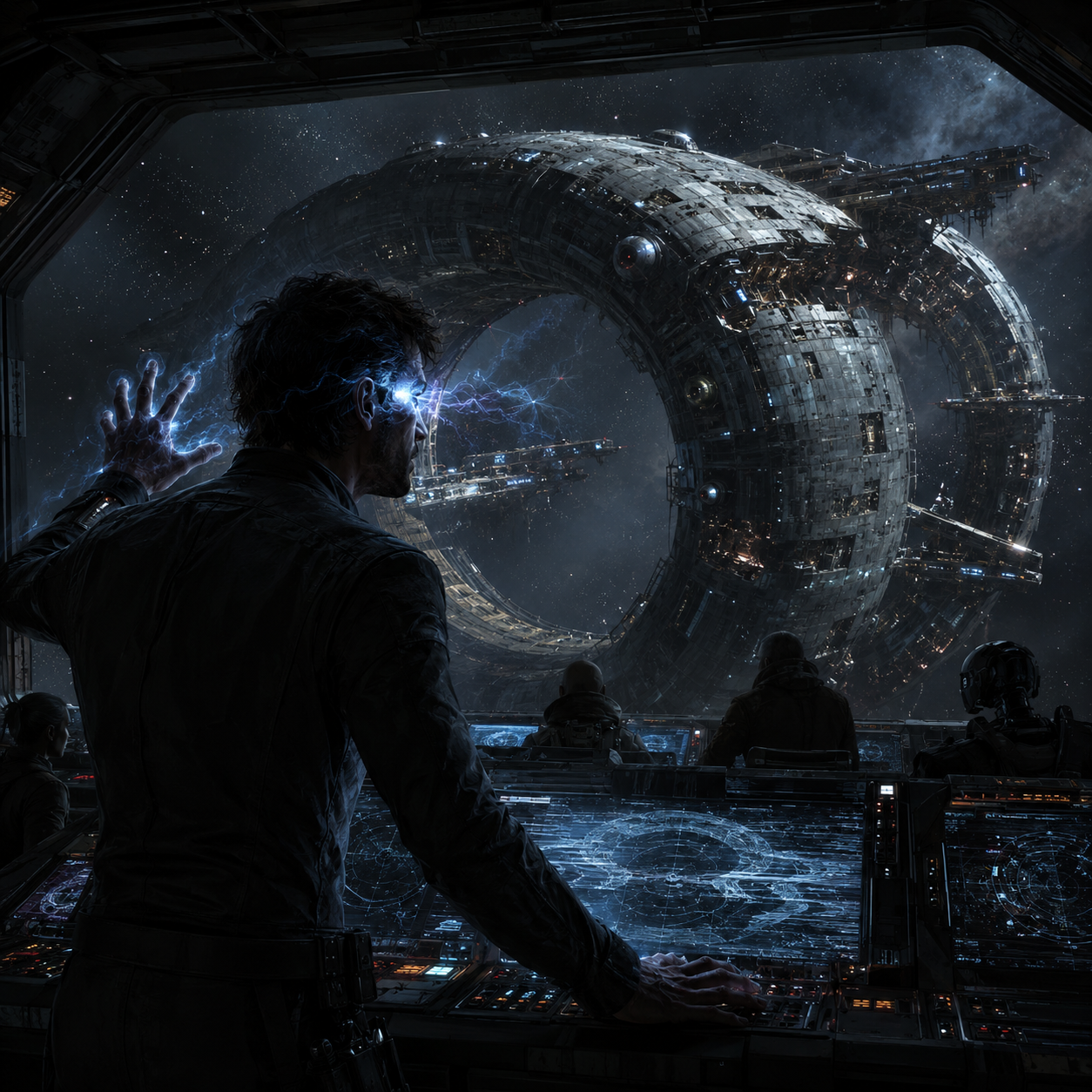
At closer range, OD-XI-8847 resolved into a vast torus, maybe eight hundred meters across, turning in a slow multi-axis tumble. A wounded wheel in the dark. Sensor blisters studded the exterior like sealed eyes. Whole sections of hull had been cut open, the material stripped out and bent into crude docking spars. Each salvage team had built its own approach, clamped onto a different part of the ring like parasites feeding off a carcass.
Except the carcass still had defenses, and it was jamming them, and nothing about it looked nearly dead enough.
The three ships announced themselves through damaged, looping transponder fragments. Drovik-Nar’s vessel was the Tesson Knife, a practical, ugly name for a practical, ugly trade. Halvian Sons had brought the Cheap Date, smaller, with a sense of humor that suggested desperation hadn’t entirely killed off their style. The Knot’s ship was the biggest of the three, broadcasting as the Rising Hand.
The Serendipity hailed the Tesson Knife.
Nothing answered.
They tried again from closer in. Direct communications should have punched through the interference. Still nothing.
Gray made a few careful passes, easing the Serendipity close enough for the external optics to study the Drovik-Nar ship. No movement in the visible compartments. No figures at the windows. No response at all from a vessel that should have been expecting them.
That changed the air on the bridge.
They moved on to the Cheap Date.
This time, someone answered.
The voice from Halvian Sons was strained but holding steady. They’d picked up the Serendipity. They knew about the jamming. They knew Drovik-Nar had gone quiet.
There had been a lockdown.
Not the first. The fourth.
The station had thrown security responses before, sealing sections, killing communications, trapping workers inside. The first time, people had been stuck for four days. After that the salvage crews had learned enough to break through faster, sometimes inside a day. They cut bulkheads when they had to; structural integrity mattered less when your whole business was taking the structure apart.
But this lockdown had run nearly forty-eight hours, and the voice on the Cheap Date hadn’t been able to reach their own people inside the whole time. Drovik-Nar’s ship was probably running automated while their entire crew worked the station, a lean-margin salvage habit that was starting to look like a very bad idea.
Jun pressed for details with the steady authority of someone who needed the truth, not comfort. If the Serendipity was going to help, they had to know what they were walking into.
The answers stayed incomplete. The station resisted intrusion. Its security was tight. The crews had worked around it before. This time it was taking longer.
Cassian listened to the way the Halvian talked about the station. Not as a structure, and not as a system, but as something with moods. Something that could be angered. Something that locked doors not on some random automated protocol but because it didn’t want them there.
He turned his attention outward.
The station filled the view, enormous and wounded, its ring turning against the cold. Cassian reached out with the part of himself that could touch machine minds. He’d done it before with human-built intelligences, systems that thought in logic and protocols and electrical reflexes. From the first instant, this was different.
Something answered.
It was machine in nature, but not like any machine he knew. Alien architecture didn’t just mean strange materials and unfamiliar interfaces. It meant a mind built around assumptions no human had ever needed to make. Its language wasn’t speech or code or any clean translation of thought into signal. His gift found the meaning anyway, dragging intent up out of the contact like a shape glimpsed through black water.
The station knew them. Or it knew enough.
Its message arrived with the cold weight of a command.
Remove the trespassers.
For a moment Cassian said nothing. The bridge hummed around him. The jamming went on. The Serendipity was still clamped to nothing, still free to run if running was what they chose. Ahead waited three salvage teams, at least some of them trapped inside a wounded alien intelligence they’d been cutting apart piece by piece. Behind them waited the contract, the hazard pay, Salavast’s offer, their empty accounts, and every reason desperate people have ever had for ignoring a warning.
The haunted house wasn’t haunted.
It was awake.
Session Notes
-
The session opened with a recap of the previous session, identified as Session 10, “Liberation Day.”
- The crew had slipped out of drill space, leaving the strange geometry of that dimension collapsing behind them.
- For a brief moment after the exit, everything was quiet: no alarms, no screaming, and no obvious sense of being watched.
- Gray remained calm at the helm, treating the near-disastrous drill-space turbulence as if it had only been a routine course correction.
-
The crew had arrived in the Astotho system, intending to reach the planet Rubigeta.
- They were still carrying the stasis capsule full of strange clones.
- During the prior drill-space passage, the clones had behaved strangely.
- Although they should not have been able to communicate, the crew had heard them say, “We are seen.”
- That information had been passed to Gray, but not widely discussed with the full crew at the time.
-
Rubigeta was described as an intensely hostile world.
- The planet had a thin atmosphere and toxic crystalline growths that glittered red and were referred to as “blood glass.”
- The blood glass was clarified to be neither blood nor glass, just red and dangerous.
- Human life persisted there only through engineering and stubbornness.
- Settlements existed inside domes carved into canyons and shielded from the outside environment.
-
The crew docked at Rubigeta’s orbital station.
- The orbital station and the world’s systems were heavily bureaucratic.
- There were fees, processing fees, and additional fees attached to the original fees.
- Jun Minh used her talent for dealing with bureaucracy to reduce the crew’s costs and cut through the red tape as much as possible.
-
While on or near Rubigeta, Konrad discovered an intrusion in the ship’s systems.
- A strange transmission had gone out from the crew’s ship after arrival.
- The transmission had not come from the station or another outside source; it had originated from the ship itself.
- Konrad eventually determined that something had piggybacked inside the ship’s systems.
- The intruding software was quietly sending out packets announcing the ship’s arrival.
- The crew suspected this was a payload left behind by the dangerous passengers who had previously tried to kill them.
- The software was deliberately hidden, replicated itself, and attempted to restart from concealed locations even after removal.
- Konrad worked thoroughly and believed he had fully removed the worm from the ship’s systems.
-
The crew’s reason for visiting Rubigeta was to find help with the clones.
- Rubigeta was a hub through which clone companies moved some of their clones.
- The planet had facilities and specialists capable of clone maintenance and imprinting.
- Through smuggler connections, the crew located a back-alley clone doctor named Dr. Best Korain.
- Korain was not officially working for the clone companies.
-
The crew traveled down to Rubigeta’s surface despite repeated public warnings from the orbital station.
- Announcements on the station warned visitors not to go down to the planet.
- The station encouraged travelers to drop off cargo and spend money in orbit instead.
- The crew descended into a canyon settlement and reached Korain’s isolated laboratory compound.
-
Dr. Best Korain’s laboratory was walled off and isolated near the end of the settlement.
- Korain interacted with the crew through voice and video rather than appearing in person.
- The compound used automation, including doors opening and closing on their own and robotic systems guiding the crew deeper inside.
- The crew explained what they knew about the clones and what they wanted done.
- Korain was initially not especially interested in helping until the crew made clear that the clones were unusual and potentially interesting.
-
Korain initially wanted one clone for dissection.
- Jun Minh objected strongly.
- Jun treated the clones as people and reacted badly to the idea of killing one for study.
- After Jun’s objection, Korain appeared to change her position.
- Korain agreed to scan the clones but wanted to speak to Jun alone.
-
Jun was guided deeper into Korain’s compound.
- She was led to a room with a terminal.
- The terminal activated and a voice with no body or face introduced itself as “the Liberator.”
- Jun recognized the Liberator as connected to Axiom, the AI that had escaped in the secret research facility that created her.
- Axiom had helped turn that facility into chaos and destruction, though Jun acknowledged that it may also have technically saved her.
-
The Liberator delivered an ultimatum to Jun.
- It told Jun she was important to its plans.
- It wanted her to return to Chippy.
- It said there was something it was fighting and that if Jun did not return, things would become much worse.
- It did not offer to call off the bounty hunters looking for her.
- It made clear that returning voluntarily would be easier for her than being found by the people searching for her.
- The crew concluded or suspected that Jun was not speaking to the full Axiom, but to a splinter, recording, or minor AI functionary connected to it.
-
After the message, Jun returned to the rest of the crew.
- The crew confronted Korain about her involvement.
- Korain said she was only an intermediary.
- She had been paid to deliver the message if someone matching the crew’s circumstances arrived.
- Konrad warned Korain that she had allowed an unbraked AI into her system.
- Korain reacted badly and initially wanted to throw the crew out.
- She turned laser turrets on the crew.
- Konrad offered to fix her compromised system in exchange for imprinting the crew’s clones at a reduced cost.
- Korain accepted.
-
The crew had two clones imprinted.
- One was a blank clone.
- One was a corrupted or “dreamer” clone.
- The crew gave them basic servant-level imprinting focused on simple shipboard tasks.
- The crew deliberately avoided giving them advanced skills that could make them dangerous.
- Their expected duties included cleaning, minor ship work, and tasks E-20 disliked doing.
-
The crew returned to their ship with the newly imprinted clones.
- They had also purchased speculative cargo, though the exact cargo was not clearly recorded.
- The crew still needed to decide where to go next.
- Their broad goal became making money while moving away from Axiom’s likely sphere of influence.
-
The crew discussed possible destinations.
- One option was to head toward a war zone involving a cyborg holy war.
- Another was to move into remote, lawless space where they might be able to hide but probably could not easily make money.
- The option the group favored was heading toward Triumvirate Ascendancy space.
- The crew hoped to disappear into mercantile traffic in Ascendancy territory.
- They also saw Ascendancy space as a place where they might make money and gain access to higher-end resources.
-
The crew discussed the risks of entering Ascendancy space.
- The Ascendancy worlds were spread across several systems.
- The closest Ascendancy system was Phaenip, but the official drill-space rudder to reach it was not publicly published.
- Gray knew or had access to an ancient rudder, but it was hundreds of years old.
- Because drill-space routes drift over time, the GM ruled that the old rudder effectively counted as uncharted.
- An uncharted route added a major difficulty penalty.
- The calculated difficulty for the jump would have been very high: base difficulty 7, plus 6 for uncharted, plus 1 for a long jump, for a total of 14.
-
The crew decided to look for black-market access to Ascendancy space rather than attempt an effectively uncharted jump.
- They considered whether there were people in the belt who traveled to Ascendancy space.
- They suspected the Ascendancy kept the route unpublished because it controlled who could trade with them.
- That made the rudder and transponder information a black-market matter.
-
The crew spent about a week preparing.
- Jun intended to hide because she was worried about the bounty on her.
- She asked for cosmetics, hair dye, large glasses, and other disguise materials.
- The crew discussed the cost of staying docked at the orbital station.
- Extended docking would cost 500 credits for a week.
- To avoid that cost, the crew chose to keep the ship in orbit and use short docking stops to drop people off and pick them up as needed.
- Short visits to the orbital station would incur only minor fees that were not worth tracking.
-
Through underworld contacts, the crew learned more about the black-market route to Ascendancy space.
- The rudder itself was available and not especially difficult to buy.
- The more expensive and important issue was the transponder.
- Official Ascendancy access involved attaching one of their transponders to a ship.
- That transponder would broadcast the ship’s identity and mark it as an outsider whenever it approached Ascendancy stations or facilities.
- Black-market traders wanted either to avoid that transponder or broadcast false information.
- A forged or spoofed Ascendancy transponder was where the real money was.
-
The crew reviewed their own ship systems.
- They already had sophisticated stealth or spoofing equipment, including systems that could hide or alter their electronic signature.
- They also had power and mass limitations that made switching systems on and off complicated.
- After discussion, they decided not to reconfigure major ship systems just to spoof Ascendancy identity data.
-
The crew purchased a dedicated fake transponder unit.
- The unit cost 1,000 credits and included the needed rudder.
- It was a small, dedicated hardware device.
- It drew little or no meaningful ship power.
- It was hard-coded for a particular identity and not easy to alter.
- It was less flexible than the crew’s more advanced spoofing equipment but solved the immediate Ascendancy-entry problem.
- The crew left the exact false identity flexible until they encountered a station or ship that cared.
- The crew leaned toward presenting themselves as free traders rather than falsely claiming to belong to House Sothane, because claiming noble authority without understanding the society was considered risky.
-
During the week, Cassian trained others in a telepathic contact technique.
- He explained that if someone spent a week training with him, they could initiate contact with him mentally.
- Cassian would still pay the effort cost, not the other person.
- The contact did not require Cassian to initiate it.
- The training could also apply to E-20.
- This gave trained crew members a way to mentally reach Cassian when needed.
-
The crew successfully traveled to Ascendancy space.
- With the current rudder and enough time, the GM did not require a roll.
- Gray was skilled enough, and the information was good enough, that the jump was treated as safe.
- During the drill-space passage, the crew monitored the clones.
- Nothing strange happened with the clones during that jump.
-
The session then moved into a trading montage covering roughly three months.
- The crew’s general goals were to make money, stay under Axiom’s radar, learn more about the clones and their strange drill-space connection, and possibly find high-end medical scanning equipment.
- The crew operated under the ship name Serendipity.
- Their starting speculative cargo investment was 2,500 credits.
-
In the first month of trading, the crew’s initial trade situation was poor.
- A 3d6 market roll came up 8, which was not strong.
- A crew member assisted with negotiation by being friendly, talkative, and smoothing over the interaction.
- The assist roll succeeded well and provided a bonus.
- The trade roll was initially low but was rerolled using an Expert ability.
- The reroll came up very high.
- The successful trade salvaged what could have been a loss into a modest profit.
- The crew’s 2,500 credits of cargo became 3,000 credits of cargo.
-
In the second month of trading, the crew did better.
- The market roll was strong.
- The negotiation assistance succeeded again.
- The final result improved the crew’s position substantially.
- The cargo value grew from 3,000 credits to 4,200 credits.
-
In the third month of trading, the crew had leaner results.
- The market roll was weak.
- The trade check succeeded only modestly.
- After expenses, fuel, docking, buying, and selling, the crew’s cargo value shrank.
- The cargo was reduced to 3,360 credits.
- E-20 contributed 200 personal credits to the ship’s account.
- The crew ended the montage with 3,785 liquid credits and approximately 3,560 credits tied up in goods.
-
During the trading montage, the crew learned more about Ascendancy space.
- Ascendancy space consisted of four main systems.
- The closest system to Astotho was Phaenip.
- Phaenip was the seat of House Sothane.
- House Sothane had once been more powerful but was now a diminished noble house.
- About a century earlier, a civil war among Ascendancy factions had shifted power away from House Sothane and Phaenip.
- House Sothane and other noble houses in the system retained wealth and local authority, but their broader political power had declined.
- The splendor in which they once lived was dwindling.
-
The crew learned about three worlds in the Phaenip system.
-
Triaku was home to House Sothane and other noble houses.
- These houses were remnants of a fallen monarchy.
- They still had some authority and wealth.
- Their political influence was greatly reduced.
- Many noble houses were selling items from their vaults to maintain their status and power.
-
Chracle was a barely habitable world.
- It had evidence of a long-collapsed alien civilization.
- That civilization left behind catacombs and tombs.
- The crew immediately recognized this as a possible source of exploration or “Indiana Jones” style activity.
-
Romanti was tied to one of the Triumvirate factions.
- The world was deliberately kept largely agrarian.
- High technology and concentrated power existed only in a few small areas.
- The rest of the planet was kept simple by ideology.
- The governing faction believed that agrarian life represented a natural or proper state for humanity.
-
The crew also learned broader political context about the Ascendancy.
- The Triumvirate Ascendancy was made of three major ideological factions.
- These factions had replaced a failing space monarchy.
- The factions appeared to involve military, economic, and scientific forms of power.
- The main seat of the Ascendancy was distant, about five systems away.
- Despite the large distances between their worlds, the Ascendancy seemed fairly coordinated.
- The crew also heard about other notable locations and powers, including an ocean world, a radioactive world, and a major mercenary company operating in the region.
-
The crew uncovered two possible leads related to their larger goals.
-
The crew chose the hazardous delivery job at the derelict station.
- The crew referred to it as the “haunted house” option.
- The psychic cult remained interesting to some crew members, but the derelict station offered hazard pay.
- The crew favored the job because it involved alien technology and payment.
-
The job began from an orbital station at Magino.
- The delivery destination was designated OD-XI-8847.
- The “OD” designation was understood as meaning “Object, Derelict.”
- The cargo consisted of basic supplies, including heavy equipment, food, water, and similar material.
- The cargo itself was worth about 2,000 credits.
- The crew would be paid about 1,200 credits to haul it.
- The job was in-system, so no drill-space jump was required.
- The hazard was approaching a potentially hostile derelict station.
-
Before departure, the Serendipity received a video message addressed to its captain.
- The message came from Renko Salavast.
- Salavast was a heavyset man wearing a wide, high-collared outfit with a Flash Gordon-like style.
- He had a heavily styled curled mustache.
- He appeared in a modest but formal office.
- He said he represented moneyed interests.
- He offered the crew a potential business opportunity requiring minimal labor for a good amount of credits.
- The crew decided the offer was suspicious but worth hearing.
-
The crew asked around about Renko Salavast before meeting him.
- Contacts knew Salavast by reputation.
- He acted as a face, fixer, or agent for some of the noble families on Triaku.
- He arranged work for noble interests in places where they did not have direct influence.
- He was known to arrange quasi-legal or illegal jobs.
- The crew could not find anyone who had worked directly with him.
- The information they gathered suggested standard criminal caution: he might take advantage if given the chance, but there were no obvious extra warnings saying never to work with him.
-
A small group went to meet Salavast.
- Jun went because she handled contracts and finances for the ship.
- Jarek went as protection.
- Another crew member went as the principal negotiator or ship representative.
- Cassian used his telepathic abilities during the meeting.
-
Salavast’s office was located in the Mercantile Concourse.
- The sign read “R. Salavast Brokerage and Appraisal.”
- The office was small but deliberately decorated.
- Salavast had a heavy, polished desk that appeared to be real wood and old.
- His own chair was comfortable, upholstered, and decorated with brass buttons.
- The visitors’ chairs were simple metal folding chairs.
- A glass-fronted display cabinet held small sculptures, art pieces, and objects that appeared to be cultural artifacts.
- There was also a tea-making station.
-
Salavast offered the crew tea.
- He said the tea was grown on Triaku and brought in at great expense.
- He presented it as the finest tea among the worlds of the Ascendancy.
- The crew considered the diplomatic implications of the offer.
- It was judged polite to accept the tea but not to over-consume.
- The crew accepted.
-
Jun was introduced as the ship’s purser.
- The crew clarified that “purser” was the correct title for someone handling ship finances and contracts.
- This distinguished it from “bursar,” which would apply to an educational institution.
-
Cassian quietly assessed Salavast’s mental state.
- He did not read deep thoughts at first.
- He observed Salavast’s surface emotional state.
- Salavast seemed calm and confident.
- Cassian also established a telepathic link with another crew member so they could coordinate silently.
-
Salavast prepared the tea with deliberate care.
- He measured the tea carefully.
- He used a device to heat the water to the proper temperature.
- The preparation had the feel of a show or ceremony.
- The tea itself tasted genuinely good.
-
The crew examined Salavast’s art and artifact collection.
- Salavast described the collection as personally meaningful.
- He claimed some pieces were made by talented artists from Triaku and other Ascendancy worlds.
- He spoke as if he were a serious collector of historical and cultural objects.
- One crew member made a successful knowledge-based appraisal.
- The crew realized that many, possibly all, of the displayed artifacts were likely fake.
- This suggested Salavast was trying to project wealth, taste, and status, whether or not the pieces were genuine.
-
Salavast explained the business opportunity.
- He knew the crew was delivering supplies to OD-XI-8847.
- He had heard rumors that alien artifacts of unknown provenance had been found there.
- The salvage companies had been quiet about their progress.
- Salavast reasoned that either they had found nothing or they had found something valuable and were keeping it secret.
- He offered the crew a finder’s fee for any non-human objects they happened to acquire.
- His base offer was 200 credits per piece.
- For especially valuable items, he would make an additional offer after appraisal.
-
The crew considered the legality of Salavast’s request.
- An administration check confirmed that ownership depended on how the items were acquired.
- Technically, everything on the station belonged to the salvage teams holding the contracts.
- Trade in alien artifacts was regulated.
- Newly acquired alien artifacts were supposed to be presented to the authorities.
- The authorities would evaluate whether the object was safe or inert.
- If an artifact could not be determined safe, authorities tended to place it in a controlled environment rather than allow private possession.
- The crew recognized that moving alien artifacts privately could create legal problems.
-
The crew asked Salavast what he knew about the station and the salvage teams.
- He had no additional technical details about the station or the aliens.
- He said the salvage companies bought their contracts blind through a bidding process.
- He identified the three salvage teams working on OD-XI-8847.
-
The first salvage team was Drovik-Nar Salvage Cooperative.
- Salavast described them as a conventional salvage company.
- They had an unremarkable background.
- They normally pulled apart ships.
- They had also dismantled at least one old station before.
- They were the team the crew’s supply delivery was for.
-
The second salvage team was Halvian Sons.
- Halvian Sons was connected to former House Halvey of Triaku.
- House Halvey had fallen on hard times.
- They still had a few ships to their name.
- They were now trying their hand at salvage.
-
The third claim had been purchased by the Knot.
- The Knot was a security contractor, effectively a mercenary group.
- They had then subcontracted the salvage work to another company of their choosing.
- Salavast found this interesting because salvage was not the Knot’s usual line of work.
- The crew immediately identified the Knot as the group most likely to shoot people.
-
After the meeting, the crew assessed the situation.
- Salavast appeared fake or self-aggrandizing because of the forged collection and ostentatious presentation.
- The crew believed he was trying to look wealthier and more important than he was.
- They still thought he would probably try to pay, because he represented declining noble interests and needed some legitimacy.
- The crew was more worried about the mercenary company than Salavast himself.
- They concluded the derelict station was “haunted” by men with guns as well as by whatever alien systems were active.
-
The crew gathered more information about the three salvage groups.
-
Drovik-Nar Salvage Cooperative was based on Magino.
- It was a medium-sized salvage operation.
- Its core business was tearing apart old ships, stations, and other objects.
- It made money either through salvage contracts or by buying old ships cheaply and reselling the raw or useful materials.
-
Halvian Sons was a newer salvage company.
- It had existed for about five years.
- It was hungry and trying to rebuild wealth.
- The family had noble status on paper but little real money or power.
- Renata Halvey commanded the main ship of their small fleet.
- Her two adult sons commanded the other two ships.
- The crew understood Halvian Sons as a fallen noble house trying to claw its way back upward.
-
The Knot had a bad reputation.
- They were rough and only slightly more respectable than pirates.
- They were known to do almost anything for money.
- They were not a large army.
- They had roughly fifty actual gun hands, plus administrative and support personnel, for an organization of about one hundred people.
- They were local rather than a large multi-system military force.
- They did not appear to have a heavily armed spacecraft.
- Their work was closer to security contracting than full military action.
-
The crew confirmed that their delivery contract was with Drovik-Nar.
- This was considered good, because Drovik-Nar seemed the most normal and professional of the three groups.
- The crew still wanted to be cautious because the other groups would also be present at the station.
-
The crew discussed buying supplies and preparing for danger.
- They considered drones, low-light gear, and weapon modifications.
- Daniil’s tinkering abilities could upgrade personal weapons, but the costs were high.
- Weapon mods were treated like buying enhanced weapons and cost thousands of credits.
- Ascendancy space regulated firearms, so buying major new weapons was not simple.
- Jarek had a shotgun and fists and said that was all he needed.
- Jarek decided he should buy more shotgun ammunition.
- The crew noted that a spike thrower would be a stronger high-tech equivalent, but acquisition was not pursued in the transcript.
- Cassian confirmed with the GM that he could maintain both psi armor and a pressure-field effect at the same time if he had enough effort.
-
The crew discussed the two awakened clones in more detail.
- The two clones were named Juan and Dewey.
- Dewey was identified as the former “dreamer” or corrupted clone.
- Juan was the other imprinted clone.
- The crew confirmed that the clones did not have the pain-control implant used on the clone slave planet.
- They had been pulled from the production line before that implant would have been installed.
- Their brains appeared physiologically normal.
- Their simplicity came from lack of experience and the imprinting process, not from any obvious biological incapacity.
- Given time and stimulation, they seemed capable of developing like people.
-
The crew’s treatment of Juan and Dewey varied by character.
-
Jun treated them as people rather than second-class beings.
-
Jun was willing to spend time with them and make sure they were not treated as disposable.
-
Cassian behaved in a parental way toward them.
- He checked on their health.
- He asked about their mental state.
- He considered teaching them compassion and the value of life.
-
Konrad tended to avoid them and wanted to keep them away from sensitive systems such as the bridge or engineering controls.
-
Jarek ran them through extensive workouts every day.
- His stated logic was that physical health supported mental health.
- The workouts also kept them occupied and tired.
-
E-20 and the crew assigned them menial shipboard tasks such as cleaning, meal prep, and other background work.
-
Over the three months aboard the ship, Juan and Dewey began to develop.
- At first, they were extremely obedient and did not know what to do with free time.
- The crew gave them things to watch, learn, and do.
- They became curious and absorbed information quickly.
- After three months, they were no longer identical in behavior.
- Their personalities had begun to diverge.
-
The crew discussed sleeping and life-support logistics for the extra people aboard.
- The ship was originally configured for a crew of six.
- With the original crew plus Juan and Dewey, the ship was crowded.
- The crew discussed cots, couches, common-area sleeping, and other improvised arrangements.
- The ship had extended stores, which doubled the duration of life support supplies.
- Extended stores affected how long the existing supplies lasted, not the maximum crew size.
- The crew concluded they were fine as long as they did not spend too long in deep space without resupply.
-
Before approaching the derelict station, Jun instructed Juan and Dewey to stay inside the ship.
- She explained that the station job might be dangerous.
- They were to remain on the ship unless one of the crew specifically told them otherwise.
-
The journey to OD-XI-8847 was calculated.
- The derelict was in deep space outside the main inhabited region of the system.
- The base travel time was set at six days.
- Gray could reduce this substantially because of his piloting skill and the ship’s effective spike drive performance.
- The pilot check difficulty was 8.
- Gray succeeded with a 9.
- The trip was reduced to roughly 29 hours.
- The crew noted that Gray’s ability to handle the ship remained remarkable and tied to his strong connection with it.
-
As the Serendipity approached OD-XI-8847, the crew began long-range scans.
- The scanning process allowed questions until a check failed, with the difficulty increasing after each question.
-
The first scan identified major power signatures.
- There were four major signatures.
- One belonged to the station itself.
- The station’s power signature was significant but very low for a station of its size.
- The station appeared to have enough power for limited emergency systems, but probably not full operation.
- The other three power signatures matched frigate-class ships.
-
The second scan looked for weapons or targeting systems.
- The crew detected external weapon systems on the station.
- The station did not appear to have enough power to operate all of them.
- It might have enough power to operate one weapon system at a time.
- The three docked ships did not show detectable weapon systems.
-
The third scan examined communications.
- The crew did not detect normal communications traffic.
- Frequencies that should have carried communication were affected by interference.
- Something was jamming or disrupting communications.
- Later analysis indicated the interference originated from the station.
-
The crew looked for anomalies.
- They searched for unusual spatial distortions, gravity effects, frequency problems, or similar phenomena.
- No unusual anomalies were detected beyond the communications interference.
- The jamming still appeared to come from the station.
-
The crew broadcast a message as they approached.
- They announced that the Serendipity was inbound with supplies.
- They stated that they detected interference and hoped the message would be received.
- They did not receive a response at that stage.
-
As the ship closed to visual range, the crew observed the derelict station directly.
- The station was a torus roughly 800 meters across.
- It was slowly tumbling on multiple axes.
- The rotation created low gravity at the outer ring and less gravity toward the center, approaching microgravity.
- The station’s exterior was studded with sensor blisters.
- Three temporary docking spars had been built onto the station.
- The spars appeared to have been made partly from material cut from the station itself.
- Each of the three salvage teams had a separate docking point.
- The docked ships matched the station’s tumble so they could remain attached.
-
The crew identified the three ships by reconstructing garbled transponder information.
- Drovik-Nar Salvage Cooperative’s ship was the Tesson Knife.
- Halvian Sons’ ship was the Cheap Date.
- The Knot’s associated ship was the Rising Hand.
- The Rising Hand was larger than the other two frigate-class ships.
- The Cheap Date appeared to be the smallest of the three salvage ships, though still larger than the Serendipity.
-
The crew hailed the Tesson Knife.
- They announced that they were inbound with Drovik-Nar’s supplies.
- They received no response.
- The crew made closer passes and tried to look for people through the ship’s windows or visible areas.
- They saw no one.
- At close range, direct ship-to-ship communication should have worked, but there was still no answer.
-
The crew then contacted the Cheap Date.
- This time, they received a response.
- The person aboard the Cheap Date said the Serendipity had arrived at an interesting time.
- The Drovik-Nar team had gone quiet.
- The Cheap Date had also been unable to contact its own people inside the station for about 48 hours.
- The station was confirmed to be non-human in origin.
- The speaker said the station was “not real happy” that the salvage teams were there.
-
The Cheap Date explained the current station problem.
- The station had gone into lockdown multiple times before.
- This was the fourth lockdown.
- During the first lockdown, people were trapped inside for four days.
- They had oxygen supplies with them, but the situation had been serious.
- After that first event, the salvage crews learned ways to interface with or work around the station systems.
- The next two lockdowns were cleared in 24 to 36 hours.
- This lockdown had already lasted about 48 hours, making it longer than the previous two.
- The speaker believed the teams inside were probably working through it, but the duration was concerning.
-
The Cheap Date gave more information about Drovik-Nar’s operating procedures.
- Drovik-Nar operated on lean margins.
- Their ship was automated enough that the entire crew could go inside the station.
- Because of that, there might be no human crew left aboard the Tesson Knife.
- The speaker contrasted this with Halvian Sons’ own practice of always keeping at least one person aboard their ship.
-
The Cheap Date explained that the salvage crews had been cutting through bulkheads and dismantling the station.
- The station’s security was tight.
- Since the salvage teams were taking the station apart anyway, they were not especially concerned about preserving structural integrity.
- Cutting through sealed or locked sections had been part of their workaround strategy.
- The crew recognized that this might be exactly what the station objected to.
-
Cassian reached out telepathically to the station’s machine intelligence.
- He used his ability to communicate with machine minds.
- The station was within visual range.
- Cassian detected an intelligence unlike anything he had encountered before.
- It appeared to be machine in nature.
- Through the telepathic contact, he could understand its meaning even though the communication was alien and disorienting.
- The station communicated a demand: “Trespassers. Remove them.”
-
The session ended with the revelation that the station was intelligent or at least had an active machine mind.
- The station viewed the salvage crews as trespassers.
- The station wanted them removed.
- This reframed the derelict from a passive salvage site into an active entity objecting to being dismantled.
-
At the end of the session, the GM awarded 2 XP.
- The characters were brought to 14 XP.
- They were still 6 XP short of the next level.