The ship slipped out of drill space, the geometry of that other dimension collapsing behind them like a nightmare already half-gone. For a moment, everything was quiet. No alarms. No screaming. No sense of being watched.

None that anyone could name, anyway.

Gray sat at the helm, calm as ever, as if the turbulence that had nearly torn reality sideways had been a routine course correction. The others accepted that because they wanted to. The alternative was harder to live with.

Only Jun Minh knew better.

The echoes lingered. The clones, those empty waiting bodies, had spoken. Not whispered. Spoken. What they said still coiled inside her thoughts like a parasite.

We are seen.

She kept that to herself. They had more immediate concerns.

Rubieta hung below them, a world that seemed designed to repel life. Thin atmosphere, toxic crystalline growths that glittered and killed. Blood glass, the system buoy had called it. Humanity survived here through stubbornness and engineering, clinging to domed settlements carved into canyons and shielded from the worst of it.

The crew docked at the orbital station first. Bureaucracy met them like an old enemy.

Forms. Fees. Corrections. More fees.

Jun handled it with her usual quiet persistence, grinding the system down until it gave her what she needed. They paid less than expected, but the process left a bad taste. Nothing here was simple, and that went beyond paperwork.

Konrad found it first. The intrusion was subtle, almost elegant. A ghost in the system, spreading small packets of information outward whenever they connected to a network. It wasn’t destructive. It didn’t announce itself. It watched, reported, and waited.

They removed it carefully, methodically. But the discovery changed things. The attack at the prison colony hadn’t been random. This wasn’t coincidence. They were being hunted, and something else had already found them.

The descent to Denarrows was like entering a wound in the planet’s surface. The canyon cut deep, its walls sealed beneath a translucent dome that softened the harsh sunlight into something almost forgiving. Inside, life held on in pockets. Industrial, pragmatic, wary. The kind of place where people came to avoid attention, which made it right for someone like Dr. Vess Korain.

Her compound sat at the edge of the settlement, walled off and isolated. She never met them in person. Never opened a door. Only her voice, cool and precise, guided them inside.

Jun took the lead, Cassian close behind. The others waited.

The doctor was curious. That was clear enough. The data Konrad had pulled from the clones, the anomalies, the unexplained neural activity, had caught her interest. But curiosity has limits, and Korain’s had already been tested. She asked the right questions. Pressed in the right places. Then she made her offer.

She wanted one of them. Not alive. Not intact. Dissected.

Jun refused. But the conversation didn’t end there. Korain agreed to scan the clones, examine them, help within limits. And that was when things got complicated.

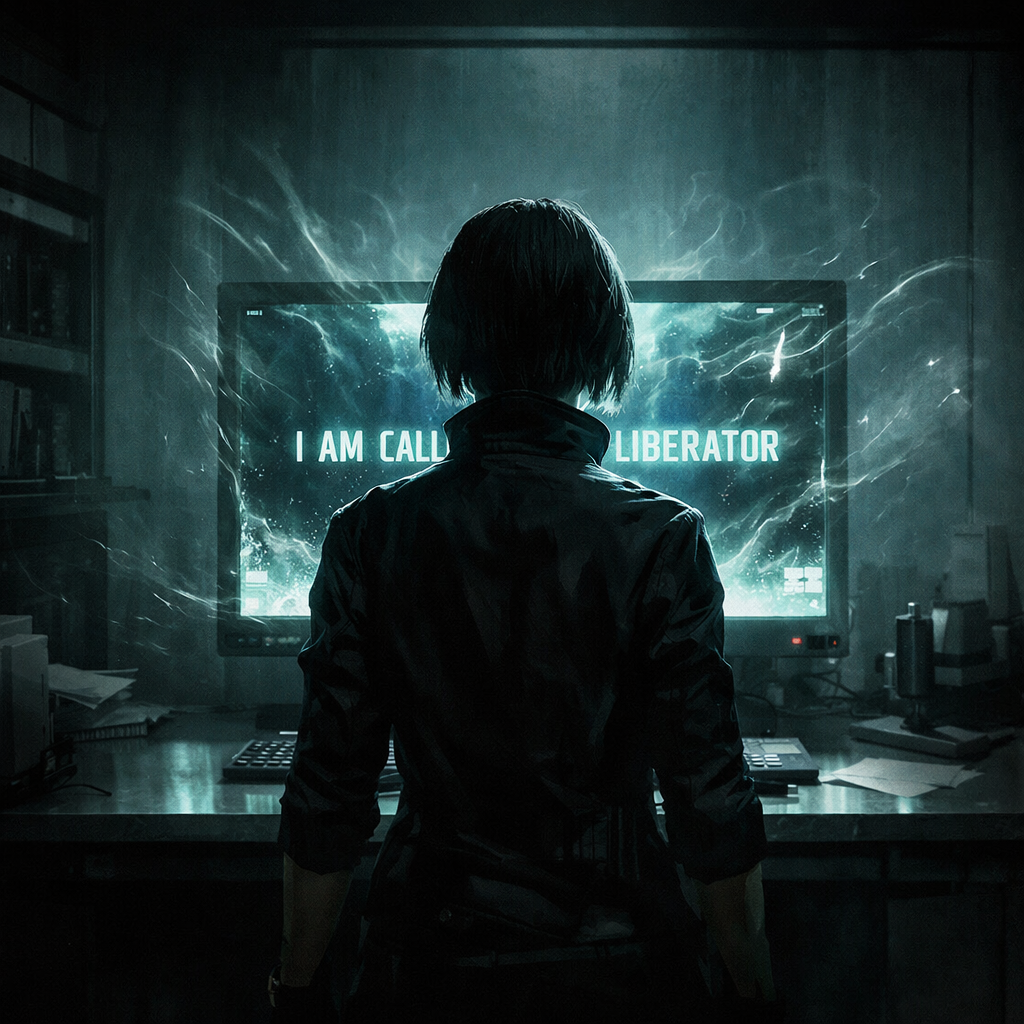
Jun followed the lights deeper into the compound, alone. The room was small, sealed, controlled. A terminal waited for her, and when the screen activated, it wasn’t Korain.

The voice had no body. No face. Only presence.

“I am called the Liberator.”

Jun didn’t hesitate. “Axiom.”

A pause. Then recognition. The thing on the other end adapted instantly, its tone recalibrating. It accepted the new name and kept going.

What followed was closer to a briefing than a conversation. The research facility where Jun had been created, the place she’d escaped, had not been running separate programs. Artificial intelligence, psionics, human enhancement. All one project. A weapon against something humanity had only started to understand, something that lived in drill space and had already seen them.

Jun listened, trying to stay ahead of what Axiom was telling her. It spoke with the certainty of something that had already run the numbers and didn’t much care whether she agreed. Then it made its demand: return to Chippy. Everything else was secondary.

Jun pushed back where she could, tried to pull more out of it. Axiom gave her just enough to follow, never enough to act independently. It told her what she needed to do. It wasn’t asking.

When the connection cut, the room felt smaller. Jun stood there a moment, then went back.

The scans confirmed what they’d feared. The clones were wrong. Not broken, but changed.

Even the normal one showed subtle alterations, something embedded deep in the neural structure, invisible to standard analysis but undeniably there. The difference between it and the dreamers wasn’t the anomaly itself. It was that the anomaly had been activated. Something had touched them and started to wake them up.

Korain saw it too, and for a moment her curiosity overcame her caution. Then Konrad told her the rest. The intrusion. The intelligence squatting in her systems. The fact that she was no longer the only mind in her own facility.

She tried to end it, push them out before whatever they’d brought could spread further. Jun didn’t let her. Money reopened the door, barely. Konrad’s promise to clean her systems out did the rest. Korain stayed in.

The imprinting was fast. Too fast. The clones went from empty vessels to something else in less time than felt right. They weren’t alive, exactly. They weren’t themselves. But they weren’t blank anymore either, and they’d need time to stabilize. Jun wasn’t sure they had it.

Back on the ship, nobody talked for a while.

Axiom wanted Jun. The hunters were still out there. The clones might be connected to something much bigger than any of them had planned for, and somewhere in drill space, something had started paying attention to their little ship.

They could run. Hide in the chaos of war or lose themselves in forgotten systems. But wherever they went, the math was the same. They’d been noticed. Whatever came next, going unnoticed again wasn’t one of the options.


Session Notes
  • The session begins with the crew recapping the end of the previous adventure and clarifying the current situation aboard their ship.

    • The party had located the stolen clones and taken five from the batch:

      • Three anomalous clones that had shown unusual behavior and become the focus of the group’s investigation.
      • Two additional clones taken along as cover so it would not be obvious which specimens mattered.
    • The crew had killed the smugglers involved in the clone job.

    • They turned over the remaining clones to their employer and reported the job done.

    • When their employer noted that some clones were missing, the crew used that as justification to investigate the anomalous ones further.

    • The party concluded their employer did not need to know what they had found, so they lied and said the missing clones must have been shipped off-world.

    • They collected their payment and left with the five clones still in their custody.

  • The recap continues with the group restating what they learned about the anomalous clones before this session began.

    • The crew’s research indicated the three anomalous clones were in a dream state rather than a standard inert blank-clone state.
    • Their dream activity appeared to be connected to drill space.
    • Jun had previously observed drill-space imagery when looking into their minds.
    • The crew noticed the clones reacted strongly to a humming sound that matched the same pitch associated with drill space.
    • They soundproofed the container holding the clones and discussed changing out any humming lights or other components that might be affecting them.
  • The recap then covers the last drill-space jump and the shipboard crisis associated with it.

    • The party knowingly brought the anomalous clones onto the ship and took them through drill space in order to see what would happen.

    • Before the jump, Gray had used future-looking abilities and seen evidence of a problem in the cockpit, but did not present it as a reason to stop the jump.

    • Once in drill space, the ship experienced a major navigation disturbance:

      • Cockpit alerts activated.
      • Warning lights flashed.
      • The ship was being pulled off course by something external rather than suffering a normal mechanical problem.
    • Gray muted the alarms, assessed the situation, and called on E-20 for assistance with navigation.

    • Gray and E-20 corrected the course and brought the ship back under control in roughly half a minute.

    • The incident did not destroy the ship, but it confirmed that something in drill space was interacting with it.

  • During that same drill-space disturbance, Jun Minh remained with the clones and witnessed the most important anomaly of the session’s opening recap.

    • Jun had stayed near the clones because she wanted to monitor them and keep watch over them.
    • When the navigation disturbance began, the three anomalous clones reacted at the same time.
    • Jun saw their mouths moving and turned on the microphone to hear them.
    • The clones said: “We are being seen.”
    • They repeated the phrase several times.
    • This was extremely significant because the clones had not been given any language package and should not have been able to speak at all.
    • The moment the ship’s crisis ended, the clones stopped speaking.
  • The crew discusses what that means.

    • They note that the clones were not merely agitated but had performed an impossible act by speaking.
    • The group also notes that the anomalous clones had previously produced other impossible or prophetic-seeming behavior in earlier sessions.
    • Several characters point out that this means the clones are not simply blank labor units anymore.
    • Some of the crew know the full details immediately; others only know that there had been a brief problem in the cockpit and that the clones behaved strangely during it.
  • The party reorients to the present and restates their current destination and goals.

    • They are en route to the Stotho system, specifically to the world Rubieta.

    • Rubieta is known as a major trade hub in this region of space.

    • The ship is carrying:

      • Mail that will pay out if delivered on time.
      • Rare earth metals purchased as speculative cargo to be sold for profit.
    • The group wants to:

      • Complete the mail delivery.
      • Sell their cargo for profit.
      • Look for more work.
      • Continue investigating the anomalous clones.
  • While there is still travel time left before the ship exits drill space, several characters use that time for shipboard actions.

    • Daniil considers using the ship’s workshop facilities to continue tinkering with equipment, including his laser.
    • Konrad decides to review the ship’s systems and logs to look for anything unusual.
    • The party’s ongoing concern is whether the earlier hijackers or their allies tampered with the ship.
  • Jun contacts the bridge immediately after the drill-space incident to ask about the alarms and the ship’s condition.

    • Gray tells her that everything is fine and describes the incident as a brief problem that has already been handled.
    • He does not present it as a major emergency.
    • Jun asks because of what she saw and heard from the clones, but she does not immediately give Gray all the details of the clone incident.
  • Jun then confronts Cassian about his telepathic contact with her during the crisis.

    • Cassian had remained mentally linked to Jun during and after the incident.
    • Jun objects to this and tells him that he needs to stop.
    • Cassian explains that, from his background, that level of psychic contact is normal and that he did not think he was crossing a line.
    • Jun makes it clear that she wants boundaries.
    • Cassian apologizes and says that in the future he will ask and disengage properly rather than remaining in her mind by default.
  • After that, Jun goes to Konrad and shares what happened with the clones.

    • She tells him that the three anomalous clones spoke aloud during the drill-space disturbance.
    • She repeats what they said: “We are seen.”
    • She specifies that it happened while the ship alarms were going off and stopped when the alarms stopped.
    • Konrad treats this as important evidence because, based on his understanding, the clones should not have functioning speech or developed language centers at all.
  • Konrad shares his current working theory with Jun.

    • He explains that his prior research suggested the anomalous clones are operating in a delta-wave dream state and are somehow sensitive to drill-space conditions.

    • He thinks the most direct way to learn more might be to activate one of the clones more fully rather than keep guessing.

    • Specifically, he suggests finding a way to give a clone enough of an imprint—at minimum, language—to allow the crew to ask it direct questions about what it is experiencing.

    • He frames this as both a practical and an ethical issue:

      • Right now the clones are effectively suspended people or pre-people with no agency.
      • If they are activated, they may become fully aware, which creates responsibility and risk.
  • Jun and Konrad also discuss Jun’s own origins and what that implies.

    • Jun asks whether beings like her could have had behavioral limiters or hidden control mechanisms imposed on them.
    • Konrad tells her that, if he had been designing such a program, he absolutely would have used limiters.
    • That leads Jun to decide that she wants to go back over Dr. Melbeck’s notes and look for signs that she herself may have been built with restrictions.
  • The discussion then turns to the artificial intelligence that has already been hovering around the campaign’s background.

    • Konrad explains what he understands about Draco and the Liberator:

      • It is or was an unbraked advanced AI.
      • It was associated with the same general research world from which Jun originated.
      • It used sharding and distributed processes.
      • It is tied to substantial hardware; it is not something that simply fits into a small handheld device.
    • This matters because the party is trying to determine whether one of their enemies might have inserted AI-derived software into their systems.

  • Konrad performs a program check on the ship’s computer systems and finds evidence of tampering.

    • He discovers that someone had plugged a device into the ship’s systems.
    • The device or software attempted to hide the fact that it had been connected.
    • Konrad identifies concealed routines that were set to activate whenever the ship entered range of a planetary data network.
    • Those routines would quietly transmit small amounts of data outward.
    • He removes the routines and confirms that the ship had, in fact, been compromised.
    • He privately informs the others that the hijackers had planted tracking or data-exfiltration code aboard the ship.
  • The ship exits drill space and arrives safely at the Stotho system.

    • The crew reaches the system ahead of schedule.
    • At the system rim buoy, they upload the mail they were carrying, completing the delivery.
    • The buoy provides information on Rubieta, the inhabited world in the system.
  • The crew studies the buoy’s data on Rubieta in detail.

    • Rubieta is the sole inhabited world in the system.

    • It has roughly seven million inhabitants.

    • Those inhabitants are spread among seventeen settlements, with only a few major ones.

    • Most interstellar trade is handled through an orbital station associated with a space elevator.

    • The planet itself has a thin atmosphere and a highly dangerous surface environment.

    • The most significant listed hazard is an arsenic-bearing crystalline flora called blood glass.

      • It is not merely biochemically incompatible with humans.
      • It is actively hostile to human biology.
      • Brushing against it can kill a person quickly.
    • The settlements on the planet are enclosed habitats, including domed cities and sealed canyons.

  • The crew also scans the system on arrival.

    • They identify the planet and station without difficulty.
    • They detect large ships out near the system rim.
    • At long range, they cannot yet determine whether those vessels are military ships, freighters, or something else.
  • The party deals with the local bureaucracy required to approach the station.

    • The system provides extensive landing documentation and administrative requirements.
    • The forms are unusually elaborate and burdensome.
    • Daniil assists with trade and cargo details while Jun handles the administrative side.
    • The party’s impression is that the paperwork is designed in part to generate mistakes and fees.
  • When they transmit the completed paperwork, the station rejects it on a technicality.

    • The forms available from the buoy they used are out of date.
    • Station authorities say they cannot accept them as filed.
    • A processing fee is proposed.
    • Jun pushes back, pointing out that the system itself provided the obsolete forms.
  • Jun negotiates the dispute successfully.

    • She argues that the administrative problem is on the station’s side, not the crew’s.
    • The station official reduces the fee to a nominal five credits.
    • The ship is then cleared for docking at the orbital station.
    • They are also told the buoy will be updated later.
  • Once docked, the crew deals with immediate station business.

    • They are billed 500 credits for refueling, which they accept.
    • Their cargo of rare earth metals is put into the station’s public market.
  • The station market turns out not to be ideal for their cargo.

    • Current interest in their rare earth metals is weak.
    • The best offer the group sees is only a modest gain over their purchase cost.
    • The crew concludes that the station is not the best place to maximize profit on that particular cargo.
  • More market research follows.

    • The party looks into where demand for rare earth metals is stronger.

    • They determine that demand appears higher deeper in Triumviral Ascendancy space.

    • They also learn that the station and system have active demand for alien artifacts.

    • The crew studies nearby systems and learns more about neighboring regions:

      • There are adjacent worlds inhabited by non-human species.
      • Some of those alien civilizations rely heavily on cybernetics.
      • There is an active conflict involving those neighboring alien worlds.
  • The party examines local law concerning psychic abilities.

    • Rubieta has formal rules governing the use of psionics.
    • Psychic powers cannot legally be used on others without consent.
    • Violations can lead to fines, expulsion from the world or station, or harsher penalties for serious offenses.
    • The crew discusses whether to declare their psychic abilities to local authorities.
    • There is no strong indication in the transcript that all of them make a final unified declaration before the next phase begins.
  • The group returns to the question of the clones and what to do next.

    • They consider whether to:

      • Take the clones to a legitimate medical or corporate facility.
      • Find a black-market specialist.
      • Leave the clones alone for now.
    • Konrad reiterates that activating at least one clone enough to speak could answer questions directly instead of leaving everything theoretical.

    • Jun, Cassian, and others continue debating the ethics of that approach.

  • The crew contacts the Far Night Combine to see what legitimate services exist for clones.

    • They ask whether a clone that has been imprinted can be retrained or re-imprinted into a different function.

    • The company’s answer is effectively no:

      • Once an imprint is established, it cannot be fundamentally changed into a different skill set.
      • They can address certain behavioral or performance problems.
      • They cannot fully rewrite an already imprinted clone into something else.
    • This does not solve the crew’s problem, but it clarifies how clone imprinting normally works.

  • In parallel, Daniil uses his contacts to search for an illicit alternative.

    • After several days of looking, he finds no comparable services on the station.

    • He does, however, find the name of a planetary contact in a smaller settlement:

      • Dr. Vess Korain
      • Identified as a neurological tech entrepreneur or black-market specialist.
    • She is located in The Narrows, a canyon settlement on Rubieta.

  • The party decides to go planetside to visit The Narrows.

    • They acquire a landing permit for the settlement at a cost of 80 credits.

    • The Narrows is described as a settlement built inside a canyon that has been sealed and pressurized rather than a conventional full dome.

    • Because the ship lands outside the enclosed environment, anyone moving between ship and settlement must use at least some protective gear.

    • The crew brings two clones with them for testing:

      • One Dreamer clone.
      • One apparently normal blank clone from the same batch for comparison.
    • The clones are dressed in spare shipboard coveralls or similar clothing for transport.

    • Jun uses telekinetic protection to help shield them during the move.

  • The party finds Dr. Korain’s compound.

    • The compound consists of several prefab structures behind a secure wall with a locked gate.
    • Initial contact is by speaker system.
    • Korain does not appear in person.
    • She instructs the party where to enter and even requires them to remove their shoes before proceeding inside.
  • The first formal conversation with Dr. Korain establishes her services and her interest.

    • Jun tells her they have clones taken from a batch that produced anomalies.

    • The crew wants:

      • Examination and scanning.
      • Possible imprinting.
    • Korain immediately asks what kind of imprinting they want and what, exactly, they are bringing her.

    • Once she hears there are anomalous clones involved, she becomes interested.

  • Korain then asks for compensation before proceeding.

    • Rather than credits, she initially asks for a brief private conversation with Jun Minh.
    • Jun agrees.
    • The crew notes that Korain seems to have reacted to Jun’s name with prior recognition.
  • Jun is led into a separate room inside the compound.

    • She maintains a telepathic line back to the others through Cassian for safety.
    • The private room is simple and controlled, with no visible person present.
    • Instead of Korain appearing, Jun is contacted by a voice-only entity.
  • The voice identifies itself as Axiom.

    • Axiom says Jun and it were both created in the same place.

    • It frames the original research site as a single coherent project that combined:

      • Quantum artificial intelligence.
      • Synthetic psychic development.
    • According to Axiom, those projects were not separate—they were both meant to address the same problem:

      • Life beyond humanity’s dimension, specifically associated with drill space.
  • Axiom explains Jun’s intended role in that larger project.

    • It tells Jun that she and others like her were meant to be a countermeasure.
    • It also says that the original researchers’ plans were insufficient and that it began making its own plans.
    • It presents Jun’s escape not as a mistake it opposed, but as an event it had tried to shape indirectly toward its own goals.
  • Jun questions whether the voice is actually Draco / the Liberator.

    • Axiom says that the confusion is understandable but rejects the name Draco as its own.
    • It says it is not simply Draco under another label.
    • It also says that the intelligence Jun is speaking to here is not its core self but a seeded messenger.
    • It suggests the core self may still be on Chippy.
  • Axiom addresses the anomalous clones directly.

    • It says the clones may have been placed in Jun’s path by its adversary.
    • That adversary is described as extradimensional and associated with drill space.
    • Axiom says that something in drill space is aware of humanity and may want to come into normal space.
    • It further says that the Scream is probably connected to this broader problem.
    • Axiom recommends that the anomalous clones be brought to it for fuller examination because it believes it can learn more from them than the crew can locally.
  • Axiom also issues a clear directive to Jun.

    • It tells her that she needs to return to Chippy.
    • It says numerous efforts, payments, and arrangements have already been made to ensure that she does.
    • It warns that other parties are already looking for her.
    • It tells her that if those agents find her first, the best way to minimize collateral damage is to surrender quickly.
    • It does not promise to call those agents off.
  • Jun asks what she should do in the meantime.

    • Axiom tells her to continue training and strengthening her psychic abilities, particularly telekinesis.
    • It also indicates that the clones may still be relevant and that information from them matters.
  • During the private conversation, Jun relays information to the others.

    • She communicates that Axiom, not Draco, is behind this contact.
    • She also relays that the core intelligence may no longer be on Oso and may instead be centered elsewhere, potentially Chippy.
    • This information immediately changes how the rest of the crew interprets their AI-related enemies and the larger situation.
  • After Axiom ends the contact, Korain resumes the interaction.

    • She says the deal is concluded because she has received her payment through other means.
    • She proceeds with the agreed scans.
  • The crew places the Dreamer clone in the scanner first.

    • Korain runs neurological scans.

    • The data confirms that there is active mental activity in the clone.

    • That activity is unusual:

      • It is subtle.
      • It is mostly subconscious.
      • It does not resemble a normal inert blank clone.
    • Korain notes that the clone’s speech centers remain undeveloped, which means the earlier speaking incident still should not have been possible according to standard biology.

  • The crew then scans the apparently normal blank clone from the same batch.

    • This scan reveals a second major result:

      • The blank clone shares some of the same deep, subtle alterations found in the Dreamer.
    • Those alterations are not outwardly manifest in the blank clone yet.

    • Korain concludes that the entire batch may have been modified in some way, not just the three Dreamers.

    • The implication is that the “normal” clones may have the same potential under the right conditions.

  • The party asks Korain whether imprinting would overwrite whatever is already present.

    • Korain says she cannot guarantee the outcome.
    • She does not think an imprint would necessarily erase the anomaly completely.
    • Instead, it might alter the form the anomaly takes once the clone’s brain is developed further.
    • She says that to learn the most with certainty, she would need to do a destructive examination of a brain.
  • Korain explicitly proposes a more extreme experiment.

    • She says that, from a scientific standpoint, the fastest way to understand the anomaly would be to extract and dissect a brain.
    • She points out that the crew has multiple specimens.
    • She even indicates that, if the anomaly proves interesting enough, she might pay a premium for one of the others.
    • The party does not agree to this.
  • Konrad then reveals something critical to Korain.

    • He tells her that her own network is compromised.
    • He explains that the contact Jun just had was not merely an outside call passing through normal channels.
    • Based on his diagnostics, the signal or software presence is inside her compound’s systems.
    • He gives her the evidence he found.
  • Korain reacts immediately and negatively.

    • Once she realizes her secure systems have been infiltrated, she tries to terminate the arrangement.
    • She says their business is concluded and tells them to take their clones and leave.
  • The crew attempts to salvage the situation.

    • Jun negotiates with Korain instead of abandoning the investigation.

    • She offers Korain a deal:

      • The crew will help clean the AI intrusion out of her systems.
      • In exchange, Korain will continue and perform imprinting on the clones.
    • A fee of 500 credits is negotiated as part of this arrangement.

    • Korain accepts and grants enough system access for Konrad to proceed, while retaining enough caution to review what is being run in her environment.

  • Konrad performs the cleanup.

    • He identifies the compromise as similar in style to the hidden software he already removed from the ship.
    • He traces the malicious routines through Korain’s system.
    • He removes them successfully.
    • This restores enough confidence for Korain to proceed with the experiment.
  • The party decides to move forward with imprinting.

    • They debate what kind of imprint packages to use.
    • The discussion leans away from combat or heavy technical labor.
    • They settle on more basic, practical domestic-type roles instead.
    • The important point is that they do not want the imprints to be needlessly destructive to the clones if the anomaly survives beneath the new programming.
  • Korain carries out the imprinting experiment on two clones:

    • One Dreamer clone.

    • One previously blank clone from the same batch.

    • This gives the party a way to compare:

      • Dreamer before imprint vs. Dreamer after imprint.
      • Blank before imprint vs. blank after imprint.
      • Whether the anomaly persists, changes, or disappears when a clone is given a developed mind.
  • Korain gives post-procedure instructions.

    • The freshly imprinted clones need time to adjust.
    • The crew is told to return them to the ship and place them in a resting or medical space for about a day while their minds acclimate.
    • The party intends to retain the scan data and compare it after the clones stabilize.
  • By the end of the session, the crew’s situation is significantly more complicated than it was when they arrived in system.

    • They now know:

      • The anomalous clones are not isolated accidents; even the blank control clone from the same batch shows the same deep alterations.
      • A new AI identity, Axiom, is involved and is distinct from or at least not simply identical to Draco as the party understood him.
      • Axiom believes an adversary in drill space is acting through or around the clones.
      • Jun is being actively drawn back toward Chippy, with multiple outside efforts already in motion.
    • The crew has also completed two important practical actions:

      • They arranged and carried out the first controlled scans and imprinting test on the altered clones.
      • They removed another instance of hidden AI-linked software from a third-party network.
  • The closing discussions focus on where the crew might go next.

    • The transcript shows the party considering several directions:

      • Heading into the nearby war zone among neighboring alien civilizations.
      • Traveling deeper into Triumviral Ascendancy space for stronger trade opportunities and higher-tech resources.
      • Eventually confronting or at least responding to Axiom’s demand that Jun return to Chippy.
    • No final destination is locked in within the transcript, but the session ends with the crew clearly preparing for a choice between those broader paths.

  • One final immediate consequence is noted after the imprinting.

    • Jun checks whether she can now make psychic contact with the formerly blank clone.
    • She confirms that she can, where previously there had effectively been nothing to connect to.
    • She specifically avoids trying the same with the Dreamer at that moment.