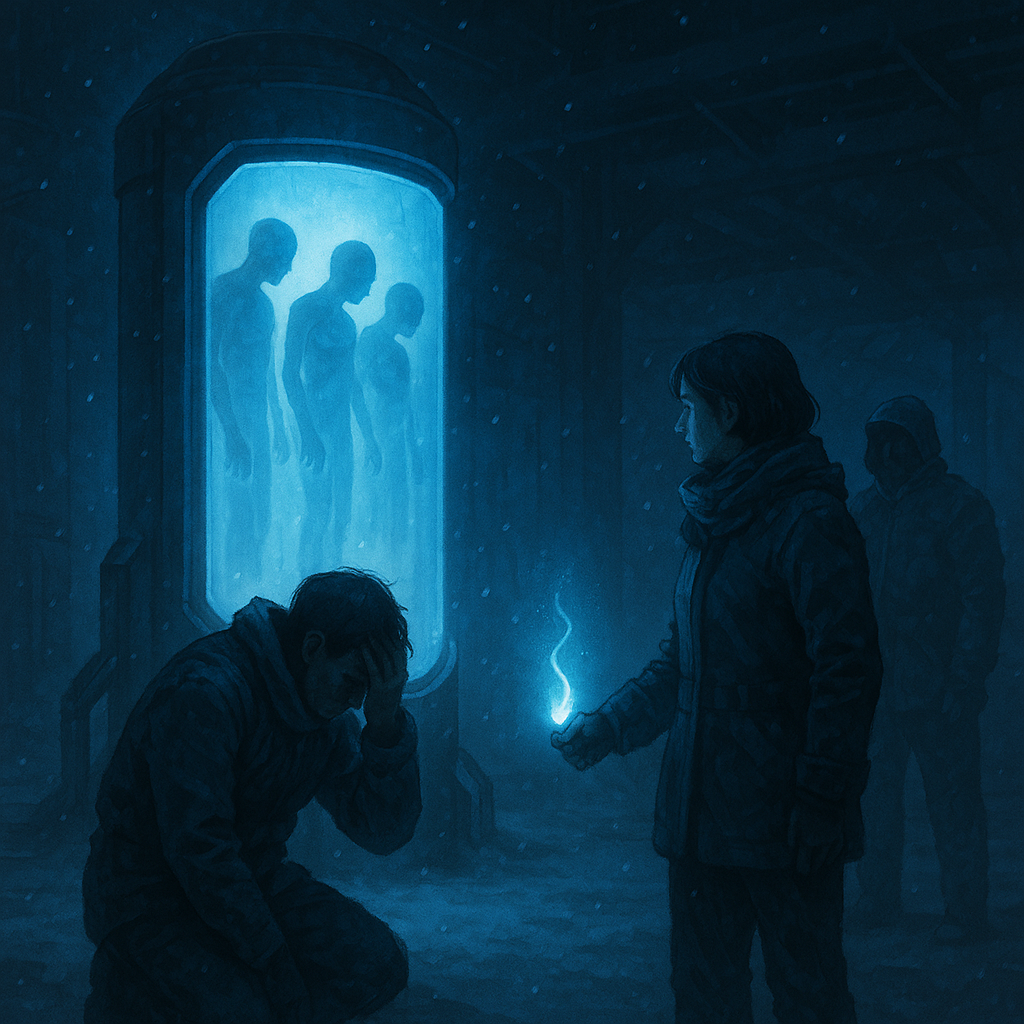
The city of Berd was all cold geometry and corporate silence—a skyline of domes half-buried in glacier light, breathing vapor into the air like beasts sleeping under the ice. Within those domes, the crew of the Celestial Princess found themselves navigating a new kind of captivity: law instead of bars, contracts instead of chains.
Their employer—an oily intermediary named Fex—had handed them a job that stank of opportunism: retrieve a batch of stolen clones before their thieves could register legal ownership. A bureaucratic heist. On Berd, property was defined by paperwork, not possession. Once the forms cleared, the clones would belong to whoever had filed them first. And Fex wanted them back before that happened.
But the deeper they looked, the stranger the job became. The clones weren’t “born” yet—minds unprinted, bodies fresh from vat—and the theft itself rested on a loophole so absurd it might’ve been deliberate. The city was full of those: legal gray zones polished smooth by decades of corporate compromise. Even theft could be lawful, if your lawyer filed quickly enough.
Jarek Thorn’s instincts itched. Freedom fighters didn’t do corporate errands, not willingly. Cassian’s mind twitched with the echoes of psychic surveillance and the weight of another government’s control. Jun Minh kept her calm through meditation, eyes sharp, voice serene, but the tension in her gestures betrayed her discomfort: this was a world that worshiped control, not compassion. And E-20, the mechanical observer, processed everything in quiet bursts of data—loyal, curious, and too naïve to recognize moral decay when it was encoded in law.
Their search led them into the seedy veins of the port zone, where illegal trades were discussed under holographic lights in bars with names like The Dark Matter Lounge. There, amid the stink of coolant and fried protein, Cassian made contact with a nervous informant—a man with a drooping mustache and the twitch of someone deciding whether to sell information or loyalty. Jun felt his fear ripple through the air like static before a storm. Cassian dipped into the man’s thoughts and found a name tangled there: Tomas Grebik, leader of the crew that had taken the clones.
Grebik’s people called themselves Clauserats—scavengers in the corporate underbelly, trading stolen bodies as assets. They were moving carefully, hiding from law enforcement and competitors alike. The crew traced a contact: a cyborg woman named Hesse, her arms metal to the shoulder, her expression cold enough to crack glass. When Rizzo met with her, Cassian brushed his mind again—this time catching fragments of betrayal. The man was describing them, selling their faces to Hesse for a handful of credits.
Jarek followed the cyborg through the port’s surveillance corridors, shadowed by E-20’s camera feed. The pursuit led to the edge of the dome, to an abandoned warehouse where the wind howled across frozen concrete. Hesse slipped through an airlock into the polar night beyond. The atmosphere out there was deadly—four atmospheres thick, biting cold, breathless without respirators. The kind of cold that punished hesitation.
They bought masks, thermal coats, and armed clothes from the Low Market—bare essentials against the world’s hostility—and stepped through the airlock into the storm. The wind clawed at them like an angry god. Above, the glacier walls loomed, blue and blind. Their breath crystallized as they trudged between derelict warehouses, searching for any sign of life or heat.
It was E-20’s sensors that found it: one warehouse warmer than the rest. Heat signatures, faint but real. Inside, someone had power running—someone alive.
As they approached, Konrad’s console pinged: a data signal from the stolen paperwork. Someone was filing the ownership forms right now. Konrad intercepted the transmission, forged a fake confirmation, and sent it back. “They think they own the clones,” he said. “But legally, they don’t own anything at all.”
When they finally entered the warehouse, frost crusting their visors, they found the container—a massive, steel-blue pod marked with the logo of the Farenight Combine. Around it gathered Grebik and his gang, guns loose in their hands, faces lit by industrial lamps. Jun’s psychic energy coalesced into a gleaming construct of light shaped like a weapon; her calm voice carried through the cold air. “We’re not here to kill you,” she said. “We just want to know what you’ve stolen—and why.”
The standoff stretched, breath steaming between them. Then Cassian’s eyes flicked to the pod. His mind brushed the edges of the lives within—and froze. He had touched countless minds before, but this was different. Behind those sleeping faces was not silence or the half-formed noise of undeveloped brains. It was light. A roaring, unbound light. Stars screaming behind eyelids. A voice that was not a voice saying You see us now.
Cassian staggered backward, shouting, blood trickling from his nose. Jun caught his fall as his consciousness recoiled. The warehouse filled with tension; weapons rose again. Jarek’s hands tightened into fists that could break metal.
When Cassian’s voice finally returned, it was quiet, strained. “Three of them. Only three are awake. And there’s something inside them. Something from the void.”
Even Grebik went pale at that. One of his crew—the nervous one, Arkady—spoke up. “That batch… they were pulled from the line after anomalies in neural calibration. They were talking before they had language. Seeing things that weren’t there.” He hesitated. “They weren’t supposed to think yet.”
Cassian’s breathing steadied. “They’re not seeing things,” he said. “They’re remembering them.”
The words landed like frost cracking stone.
The Clauserats didn’t want the clones anymore. Grebik’s voice lost its swagger; now it was only exhaustion. “We just wanted the profit. You can take them. Take them and go.”
The crew agreed, though unease lingered in every glance. The clones floated in translucent amniotic fluid, three of them faintly twitching as if dreaming. When Jun reached out with her senses again, she felt something vast, distant, and patient watching her through them—like a star’s gravity noticing a passing ship.
They loaded the pods into a makeshift transport rig cobbled from scavenged machinery. The cold gnawed through their coats as they worked. Konrad sent a message to the ship, asking Gray to run a future-sight scan, a glimpse into the next day. What would happen if they woke one of the clones aboard the Celestial Princess?
Gray’s reply came minutes later, calm but uneasy. “I see them standing. Naked. Hairless. Confused. Then… nothing bad. Not yet.”
That “yet” echoed through the ship’s channel.
Jun glanced once more at the silent pods, their glass fogged by faint exhalations. Cassian avoided looking at them at all. E-20 quietly ran atmospheric readings, noting that the power draw from the containers fluctuated every few seconds, as if synchronized with a heartbeat.
Jarek only muttered, “We should’ve left them in the ice.”
But it was too late for that. They had taken them. And whatever was waking inside those cloned skulls was now coming with them.
Recent context and arrival on Berd Party reached the planet Berd; major port city is Kalbaset (arrived via Strapmore Terminal). Off-worlder legal status: Freight ecosystem: Lore reveal: Job offer via fixer A local fixer Fex (also referred to as “FX/Effects”) approached (or was found by) the party with a gateway job: Plan: cut off the legal claim and find the thieves Konrad targeted the corporate consortium document portal: Street work to find Grebik: Surveillance at the Dark Matter Lounge A burly woman with cybernetic arms, later named Hesse, arrived; Rizzo urgently pulled her to a booth. Cassian used telepathy: E-20 and Konrad leveraged hacked CCTV to tail Hesse while Jarek shadowed at street level. Hesse exited the dome via a public airlock into a disused warehouse zone on the glacier platform (outside conditions: very cold, high-pressure atmosphere). Outfitting for the outside search (Low Market) Party purchases (ship fund initially 3,250 credits): Notes: Outside search and heat signature Tracking footprints failed due to wind-packed, hard snow and low contrast. Survey scanner used to detect localized heat; one warehouse showed a heated interior panel, implying active equipment/occupancy. At this moment, Konrad’s worm triggered: Rooftop recon of the heated warehouse The team (with Jun Minh’s telekinesis assisting access) reached the roof and looked through a thick armored skylight. Inside they saw: Breaking the skylight was rejected: it’s a pressurized, reinforced panel designed to resist serious impacts. Rear airlock infiltration Contact and standoff Inspecting the container (clones visible) The container had a clear port (and internal camera readout). Inside: Cassian attempted deeper telepathic contact with one of the three: Gang explanation and QC report A crew member Arkady explained: Konrad cross-referenced filing info: Lattice control / control systems (Berd tech context) Discussion established: Negotiation with Grebik Grebik proposed a deal: the party could take the three “defective” units, which he considered a liability, to avoid further trouble. The party noted divergent options regarding Fex (the employer): Transport prep and wake-up risk assessment The party cobbled a temporary powered rig from warehouse materials (aux batteries, a container, etc.) to move selected clones in stasis—good for ~24 hours. Debate on waking a clone: Cassian could stabilize medically; however, unpredictability was a concern. Gray Camrin used his Oracle (precognition) focusing on waking them aboard the ship within 24 hours: Provisional plan: keep the three in stasis, transport to the ship, and decide next steps regarding Fex after securing them. Additional provenance Session end state The crew had: Outstanding decisions (deferred): GM noted XP handling would occur next session.Session Notes