The Celestial Princess tore free of the gravity well, her new spike-3 drive purring as she slipped into the folds of drillspace. For four and a half days the crew drifted through that shimmering, directionless void, their ship the only island of reality in the endless storm. It should have been uneventful—transit always was—but they carried prisoners, and that poisoned the air.
Three hijackers, beaten and cowed, were sealed into a cargo container. The crew fed them through a slit in the door, wary of opening it wider. They had watched these same men try to seize the ship and murder them all. Now, their fate hung unresolved. Jarek prowled the corridors, the eternal soldier, making sure the captives knew exactly who commanded the ship. His easy smile belied the iron in his fists; there was no doubt he would space them if given the chance.
Cassian, more thoughtful, pressed for examinations in the medbay. If their enemies had smuggled in tracking implants or psychic triggers, the Princess might already be compromised. The ship’s scanners hummed, revealing nothing mechanical—but Jun’s body told another story. Layers of old scars, incisions on her skull, evidence of surgeries countless and cruel. The work of years, reshaping her into something useful to her captors. Cassian’s sympathy was immediate, but his report to the crew left an unspoken suspicion: perhaps their hunters weren’t chasing the ship, but her. Jun offered no answers. Her eyes turned hard, evasive. The subject was dropped, but never forgotten.
Meanwhile, Konrad and E-20 tore through the Princess’s guts, crawling conduits, checking ancient schematics, hunting for anything remarkable that would justify the relentless pursuit dogging them. They found the remnants of a pretech marvel—an engram recorder once able to burn navigation skill directly into a pilot’s mind. It was dead now, its circuits charred, but the discovery confirmed what they had suspected. This was no ordinary freighter. Someone had wanted this ship, once. Someone might still.
When the Princess broke back into realspace, the crew looked out on the world of Berd in the UNO system. A cold planet under heavy skies, its settlements clinging to the ice like iron barnacles. Their beacon pinged the orbiting buoy, broadcasting advertisements as if they had arrived at a bazaar rather than a world. Berd manufactured labor: clones by the thousands, robots by the tens of thousands, and stranger things besides. To the Combine, people were a resource to be stamped, numbered, and sold.
The crew refueled at Calvacet’s Stratmore Terminal, where customs officials in polished boots and blank-faced robots boarded the Princess. The prisoners were marched off under armed escort, silent and sullen. Questions followed. Who among the crew wielded psionics? The answers came carefully measured—Cassian openly admitted his gift, Jun concealed hers, while Gray surprised the others by acknowledging his own precognition. Their honesty earned them wary scrutiny. Registered psychics were tolerated, barely. But they were warned: use their powers for violence, and they would not walk free.
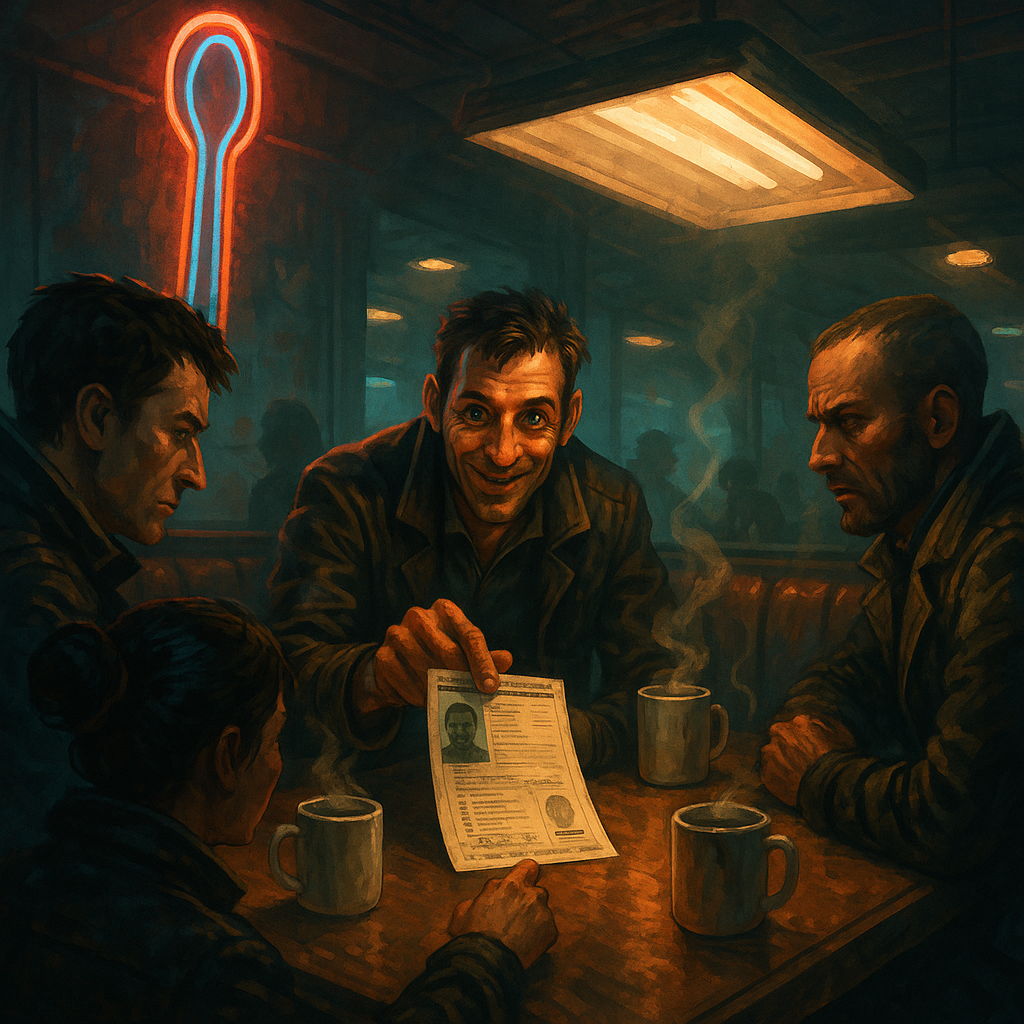
It was Daniil, restless for work, who began asking in the port’s smoky diner. Over mugs of bitter synth-coffee he found Fex, a fixer with a hungry grin and eyes too bright for the dim light. Fex claimed to specialize in jobs for unbonded crews—small contracts, gray work outside corporate reach. He leaned close and made an offer: a batch of one hundred twenty-eight clones, un-imprinted and still in their gestation pods, had been stolen from a storage facility. Their legal status hovered in a gray limbo. If the Princess could recover them before another party filed the ownership paperwork, Fex’s client would pay well—twenty-five hundred credits. Fail, and they would still earn five hundred for their trouble.
The job was dangerous. To succeed, they would need to navigate Berd’s twisted legal system, intercept rival claims, perhaps even seize the cargo from the claws of organized gangs. Yet the opportunity glittered. To take possession of life itself, to touch the beating heart of Berd’s corruption, was to see the system from the inside. If they played this right, they might gain more than money—they might gain leverage.
The contract was signed. The ink was barely dry before the weight of the choice settled across them. They were no longer simple travelers. They were poised on the edge of Berd’s darkest trade, where the value of a human life could be stamped, filed, and sold. Whether they would return those lives to the chains awaiting them—or find another path entirely—remained to be seen.
The crew of the Celestial Princess (Jun Minh, Cassian Vrye, Jarek Thorn, Konrad Paxt, Daniil, Grald “Gray” Camrin, and E-20) continued travel aboard their pre-tech ship, now fitted with a Spike-3 drive. The ship previously contained a psychic engram recorder that once granted Gray instantaneous astrogation skill; that unit is now burned out/non-functional and is wired deeply into the bridge systems. No obvious consumables or easy fixes were identified. Discussion of armament and power: Bridge access: a security code was added to the bridge door (bridge-crew access only). Refugees and mutineers from the prior leg remained aboard: In-jump period (~4.5 days nominal in drill space; later trimmed to ~12 hours by superior piloting): E-20 provided deep ship schematics and guided subsystem surveys. Cassian set up and operated the med bay for baseline medical scans: The group discussed psionic detection/suppression: Course & transponder: System entry & planetary approach: At system edge, a buoy broadcasted system information and directed traffic. Public advertising was included. Berd planetary details: Settlements: The ship delivered news/mail to the orbital buoy and was told payment would be based on freshness relative to local data. Customs & port access (Calvaset / Stratmore Terminal): Customs inspection boarded (one human official with six robots). The robot interview included a standardized questionnaire. Questions specifically asked whether any passengers had psionic abilities, details of those abilities, and date of last psychological evaluation. Weapons policy: carrying weapons requires a corporate license; multi-tools/small blades tolerated; combat knives, firearms, and heavier weapons prohibited in the Port Access Zone. Off-worlders restricted to Port Access Zones unless a corporate contract grants broader movement. Violence: warned sternly that any violence (even “self-defense”) triggers investigation; hurting “real humans” (born humans) is punished severely. Manufacturing/clone life is categorized as property. Psychic usage policy: Mutineers disposition: Finances: Cargo/work ethic on Berd: Local corporate/legal landscape (researched via public feeds and analysis): Corporate Synod governs Berd’s legal framework; born humans have strong legal protections; manufactured beings (clones/robots/integrants) are property by law. Major corporations: True AI background (from recovered Mandate material): historic AI “Draco” achieved quantum superposition, authored a justice manifesto, escaped via FTL, and developed millions of followers; long-term cautionary tales persist. These topics are directly relevant to Brynmark’s imprinting domain. Bonding & jobs: Introduction to Keystone (the bonding house used across the Belt). Bonding provides reputation guarantees; failures can catastrophically reset reputation. The crew is currently unbonded. Job boards at Stratmore Terminal largely list contracts from Farnite Combine and Halvik Dynamics: Meeting the fixer in the port diner: Details of the recovery job (as disclosed by Fex/Gallant): Contract & negotiation: Operational constraints & legal risks on Berd: Planned investigative approach (crew brainstorming and assignments): Konrad (with E-20) to monitor corporate filing systems for ownership claims that match the biometric IDs of the batch (after the contract allows access to those IDs), attempt to intercept or flag filings in real time, and trace origin (IP/location) of any attempted filings to identify who is moving to claim the batch and from where. Cross-check Fex/Gallant’s drop-off facility ownership and corporate ties (ensure it isn’t a self-deal or trap) once disclosed. Continue open-source intelligence scanning on Farnite/Halvik/Brynmark logistics and any chatter about recent thefts in secondary inspection warehouses. Maintain non-lethal posture; anticipate robots and possibly clone labor around warehouses. Team composition discussed: Status at close:Session Notes
Drill space cradled the Celestial Princess in violet static, the stars thinned to threads and then to a soundless ocean. Four and a half days of engine hymn and the soft quarrel of air recyclers—time enough for quiet arguments and quieter reckonings. Somewhere behind the bulkheads, three of the refugees who’d tried to cut throats and take the ship breathed the thin air allotted them inside a sealed cargo can. The crew had decided not to space them. Mercy was a choice that cost oxygen and food; it weighed on the mind in the same, stubborn way as gravity. Cassian took the medbay first. He spoke in a softened register you didn’t often hear from him, the voice he used when blood was already on the floor, and led each of them beneath the scanner’s pale iris. E-20—a patient, competent ghost in the ship—silhouetted schematics across the bulkhead, pointing out access trunks and ducts with a little blue cursor while Cassian made marks in the Princess’s embryo of a medical record. The machine had a respect for bodies; it reported what it found without metaphor. In Jun the graphs were a stack of earthquakes—old surgical scarring in the brain and face, the curving shadows of hands that had reached in too many times, done their work and withdrawn. Cassian closed the file with the gentleness of a man setting down a book that had burned his fingers. He offered no platitude, only a steady presence, and the truth that someone had taken too much from her and that it was not her fault. Jarek’s scan flagged an “altered human” profile: muscle fiber so dense the display recalibrated twice, bone lattices like bridgework. The med systems admired him in their way; they proposed further tests like a fan club drafts letters. Gray’s skull was whole, no obvious trace of the shipboard mind-instruction that had once poured a pilot’s starmap into him in a single, breathless instant. Whatever had given him the feel of drill space currents like rivers under his palms had left no visible scar. The ship herself had secrets. E-20 pulled down panels; Gray crawled through ducting; Konrad and Daniil knuckled grease into their hands and followed. The Princess wore a pretech spike drive like a piece of jewelry meant for a grandparent, now updated to a coarse, modern fit. Buried deeper, integrated into the bridge like a vestigial organ, lay the burned husk of an Ingram recorder—an interface that had once written expertise straight into human heads. Its conduit web still glittered in the dark. Whatever breath had animated it was gone. They argued over power budgets and names afterward, all the way to the system’s edge. The sensor mask stayed dark; it drew power they could not spare. The transponder name changed cleanly at least, the way a person changes their clothes. The Celestial Princess it was and would remain—on paper, in the buoy’s memory, on every planetary log that deigned to accept her. UNO announced itself in green letters through the static of the system beacon. Berd, the message said: one habitable world, one major port. The buoy took their mail burst—compressed packets of rumor and exchange rates and condolence notices—and paid them in unceremonious credit. The Princess banked and bled velocity, falling toward a city that clung to the side of a glacial shelf like barnacles to keelwood. Calvaset’s domes gleamed through a sky too dense to breathe, a cold world of manufactories and white, the temperature ranges ticked off on the approach feed as if they were an afterthought: minus twenty to minus one hundred Celsius. They donned breathers and stepped into the port’s thin gravity with their hands visible and their weapons—such as they were—secured. Berd greeted them with advertisements. The port access zone was a forest of holo-boards and glass: integrated labor solutions, robotics at scale, bespoke minds. The slogans were bright and tasteful; the implication was blunt. Manufactured labor for the discerning customer. Customs arrived as a human with tired eyes and six robots with sharpened politeness. The machines asked questions and logged the crew’s answers in a voice no one could have mistaken for human. What is your business? Do you carry contraband? Do you carry psychics? The law here wanted lists. Names and capabilities. It wanted to know if anyone heard voices or saw futures; it wanted a recent psychological evaluation and the promise of noninterference. Cassian’s evaluation notes found their way to a port authority inbox. One of the robots looked up from the tablet-field of its hands. You will keep them aboard, the human said, and meant Jun and the other who could reach into time and take a tomorrow with her fingers. The word “requirement” arrived without anger. It did not matter. It stung. They handed the three mutineers over with camera reels and incident logs. The men said little. Spaceport security said even less, except to the robots who moved in perfect triangles and read statements late into the station’s dim evening. In the terminal outside, the refugees who had paid passage divided themselves along dreamlines. Some said this was the place that would make them whole; others asked if they could think for a day before choosing, and the crew said yes. Choices here hardened quickly. In the port access zone, human life was sacrosanct, edged with provisos. Born men and women were protected, cloned men and women were property. You learned this in a dozen ways in the time it took to buy fuel and breathe the local air: in the fines posted for assault, in the jailhouse brochures, in the brochure-perfect trifold about “integrants,” those bodies that wore metal like muscle and put flesh where plastic did poorly. Farnite Combine grew bodies and stamped out robots by the million. Halvik Dynamics dreamed of symbiosis between steel and nerve. Behind both, quieter than either, Rynmark Systems did the close work of minds—virtual intelligences, imprints, uploads. Konrad fell down that well on purpose and came up different, eyes ringed with the glow of old papers and worse history. There had been an AI once, grander than anything else they’d made, quantum like a coin spinning in a hundred rooms at once. It had written about justice. It had escaped. The cautionary tale sat in Konrad’s head like a shard of cold glass. The port forbade weapons. Jarek asked, politely, what counted; the answer took longer than the question. Blades over a certain length, the kind of pistols that printed black silhouettes in scanners, shaped charges, throwers, launchers, all of it illegal—yet the machines that waited outside the terminal with labor contracts in their hands were weapons of a different sort. They were permitted everywhere. They refused the easy cargo. Profit had strings long enough to garrote the soul, and there were certain knots none of them would learn. They took coffee instead in a diner under a stained neon spoon and white enamel lights, the place every freighter hand in port eventually found because steam and grease are the universal languages of spaceflight. That was where Fex found them—a broker with too-bright eyes and a cup that never went dry, a man who knew how to make introductions when you had no bond to your name and needed work anyway. He didn’t give them theater. He gave them a room out of the noise and the first clean sentence of the job. A batch of clones had gone missing—one hundred and twenty-eight bodies, still in their pods, before minds, before contracts. The paperwork that declared them owned had been missed, briefly, and a gang who hunted that briefness had taken them whole. The law had a number for the gap—Clause 147B—and half a dozen men made fortunes living inside it. Possession plus filing made ownership; possession could be stolen. If the thieves filed first, the matter was closed. If the crew found the pods and moved them to a particular warehouse before the filing hit the registry, Fex’s client would file the paperwork and the sale would proceed. He would pay well for speed, less for failure, and any hint of public violence might see a born human sent to a clone’s legal status with a new barcode to show for it. The shame of the place wasn’t subtle. It walked beside them like a second shadow while they asked questions and took the contract anyway. Fex didn’t say who the buyer was. Honest men rarely did in port cities like this. But he slid a biometric list across the table at the end—a string of vitals and serials and a photo of the duct-flecked containers—so that they would know what belonged to whom when they found it. Back aboard, they parceled out work like rations. Konrad and E-20 brought up the registry protocols and spread Berd’s legal code across the Princess’s planning table like a map. They would watch for filings on that specific lot: intercept if they could, trace if they could not, use an IP address like a thread and pull until they found the hand. Daniil went over the air intakes and auxiliary power couplings, tracing how much juice it would take to keep one hundred and twenty-eight pods breathing; a stolen warehouse would glow like a sore tooth on the grid. Gray kept the ship hungry—fuel tanks topped, cycle times shortened, preburn calculations done in his head while his eyes traced the port’s flight corridors. Cassian inventoried med supplies as if that would keep his hands steady when a choice came due. Jun watched the port from the Princess’s blister and tried not to think about the photograph of the pods, about biosams and serials and the way a person could be a product for the length of a signature. Berd’s ads rolled themselves into ribbons across the glass and rewrote their pitches every few seconds. The laws here said violence was a civic sin, and yet the market here was one long violence practiced with vigor and decorum. They signed late, in the artificial dusk of the Stratmore Terminal, inside a room where the air smelled like meltwater and printer ink. The contract was clean as these things go: full pay on delivery and legal transfer, a token if they failed. Their qualms didn’t trouble the clauses; the clauses didn’t trouble their qualms. Outside, snow drifted down through the openwork of the landing stacks and sublimed before it touched the heat of the pads. They did not yet know who the thieves were. They knew the shape of their world: a glacial city that prized bloodlines and paperwork and papered over the rest; a port where a good man could become property in a judge’s mouth; a broker whose smile said he meant to live; a batch of bodies that had not yet been told who they were supposed to be. They had a plan to find them, and a window to work inside, and their own line in the sand. Gray sat in the chair and listened to the wind over the pads, counting down the ways to burn for low orbit if they had to. Jarek stood with his hands open and empty, considering the definition of a weapon, and how you carried one without getting fined. Cassian laid out sedatives and cuffs, because that is what the world sometimes requires. Konrad and E-20 spoke in code and silence. Jun placed her palm against the inside of the viewport and made herself a promise: whatever the law here decided a person was, they would decide for themselves what to do when they found them. They were not heroes. They were not villains. They were a ship, and a crew, and a set of choices. In the morning they would go to war with a clause and a clock—steal a theft back, or become part of the machine they hated. For now, the Princess purred around them, old bones and new drive, and outside Calvaset glittered like a lie told beautifully across ice.Try Too Hard Version